1. Technological Background
1.1 Fundamentals of PMMA
PMMA is a thermoplastic polymer characterized by high biocompatibility, low water absorption, and favorable mechanical properties. Its use in prosthetics is based on a combination of structural stability, processing flexibility, and esthetic adaptability. Traditionally, PMMA is processed via heat polymerization, a method that frequently results in internal stresses, porosities, and uneven material curing (Daou et al., 2023).
1.2 Difference Between Conventional PMMA and CAD/CAM PMMA
Industrially polymerized CAD/CAM PMMA blanks are manufactured under controlled conditions and are characterized by:
According to the meta-analysis by Al-Dwairi et al. (2021), CAD/CAM PMMA exhibits significantly higher mechanical stability than conventionally polymerized materials. Similarly, a network meta-analysis by Liu et al. (2025) confirms that milled PMMA materials are superior not only to conventional but also to 3D-printed denture bases.
These material advantages have a direct impact on clinical parameters such as fit accuracy, long-term stability, and fracture resistance. This explains why CAD/CAM PMMA is increasingly becoming the standard for high-quality, dimensionally stable long-term provisionals.
2. Practical Application / Use Cases
2.1 Provisionals (Crowns and Bridges)
PMMA is the leading material for esthetic long-term provisional restorations. Milled PMMA achieves a homogeneous microstructure that results in higher milling quality, precision, and durability compared to conventionally fabricated provisionals. Khairuddin et al. (2021) demonstrated that CAD/CAM PMMA exhibits significantly higher flexural strength and lower surface roughness, reducing fracture susceptibility while simultaneously decreasing plaque adhesion.
For in-house practice laboratories, this results in tangible advantages:
2.2 Denture Bases
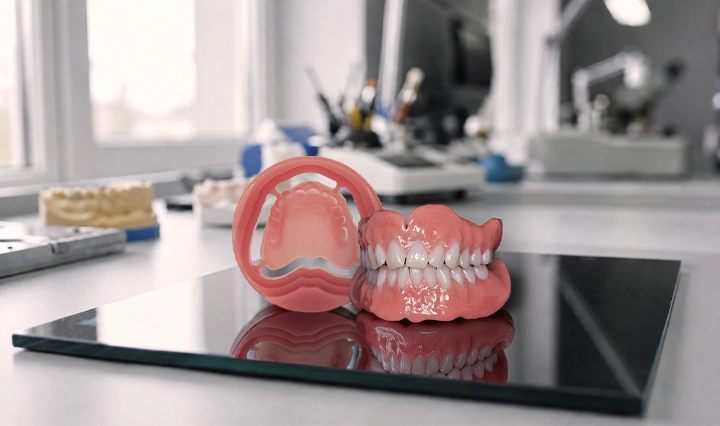
Current studies clearly demonstrate that milled PMMA denture bases are superior in terms of homogeneity and mechanical robustness. Liu et al. (2025) showed that CAD/CAM dentures exhibit significantly higher strength values than printed or conventional bases. Additionally, milled dentures demonstrate superior dimensional stability, leading to improved fit accuracy and reduced pressure points.
2.3 Therapeutic Splints
For splints—particularly night guards and therapeutic appliances—PMMA offers the following advantages:
These applications benefit significantly from the process reliability of industrial PMMA blanks.
2.4 Implant Prosthetics (Temporary Solutions)
Long-term PMMA provisionals for implant-supported restorations are gaining substantial clinical relevance due to the growing demand for immediate loading concepts. Milled temporary bridges provide:
3. Benefits for the Target Groups
3.1 For In-House Practice Laboratories
Practice laboratories benefit from the ability to fabricate high-quality provisionals directly on-site. Milled PMMA enables:
For dental practitioners such as the persona “Dr. Meier,” this translates directly into faster patient treatment and higher patient satisfaction.
3.2 For Dental Laboratories
Larger dental laboratories benefit from:
The existing body of research clearly shows that milled PMMA delivers consistently high material quality (Daou et al., 2023; Al-Dwairi et al., 2021).
3.3 For Milling Centers
Milling centers benefit particularly from:
Milled PMMA proves to be highly milling-friendly and process-efficient—an important factor for large production volumes.
4. Challenges / Limitations
Despite its advantages, PMMA has limitations that users should be aware of:
Additionally, milling results in material waste due to residual blanks compared to 3D printing. Nevertheless, for high-demand provisional restorations, the quality advantage of milling clearly outweighs this drawback.
5. Market & Future Perspectives
5.1 Developments: Milling vs. 3D Printing
The market is increasingly moving toward hybrid manufacturing processes. While 3D printing systems offer speed and cost efficiency, current research indicates that the mechanical properties of printed PMMA remain inferior to those of milled materials (Liu et al., 2025), particularly in terms of:
As a result, milled PMMA is expected to remain the preferred solution for high-quality provisional restorations in the medium term, while printed PMMA will primarily be used for rapid basic fabrication.
5.2 Material Innovations
Future developments include:
These trends indicate that PMMA will continue to play a key role in digital prosthetics.
6. Conclusion & Recommendations
Milled PMMA has established itself as a high-quality, precise, and versatile material in digital prosthetics. The extensive body of scientific evidence demonstrates that CAD/CAM PMMA is clearly superior to conventional and printed PMMA materials, particularly in terms of precision, mechanical strength, and surface quality.
For in-house practice laboratories, dental laboratories, and milling centers, this leads to a clear recommendation:
For durable, esthetic provisionals and precise denture bases, milled PMMA remains the gold standard in 2025.
FAQ Section
1. How does milled PMMA differ from conventionally polymerized PMMA?
Milled PMMA is industrially polymerized, resulting in a highly homogeneous structure. This leads to higher flexural strength, lower porosity, and smoother surfaces. Conventional PMMA often shows internal stresses and irregular polymerization zones.
2. How long do PMMA long-term provisionals last?
Clinical service time typically spans several months. However, due to the high stability of milled PMMA provisionals, many laboratories report significantly longer functional longevity, especially for implant provisionals.
3. Is PMMA biocompatible?
Yes. PMMA is one of the most extensively studied dental polymers and demonstrates proven biocompatibility and low water absorption. Milled PMMA also features particularly low residual monomer content.
4. Which indications are best suited for PMMA?
Typical indications include long-term provisionals, splints, denture bases, therapeutic appliances, and implant-supported temporary bridges. Due to its high dimensional stability, milled PMMA is especially suitable for precise fits.
5. How does 3D-printed PMMA compare?
Printed PMMA offers advantages in speed and cost, but it is mechanically weaker. Studies show that milled materials outperform printed PMMA in flexural strength, fracture toughness, and surface homogeneity.