1. Technological Background
The chairside workflow consists of three fundamental steps: digital scanning, CAD design, and machine-based CAM manufacturing. Modern systems allow these steps to be completed quickly and with high precision.
Digital Impression
Current intraoral scanners demonstrate high repeatability and reduce common impression errors. Nassani et al. (2021) report that digital impressions are now a precise alternative to traditional impressions for most single-tooth restorations. They form the essential foundation for an efficient chairside workflow.
CAD Design
CAD software generates the restorative geometry from the scan data. Modern software versions offer automated proposals, anatomical libraries, and AI-supported occlusion suggestions. Stück (2022) notes that increasing automation simplifies operation and facilitates integration into daily practice.
CAM – Milling Unit
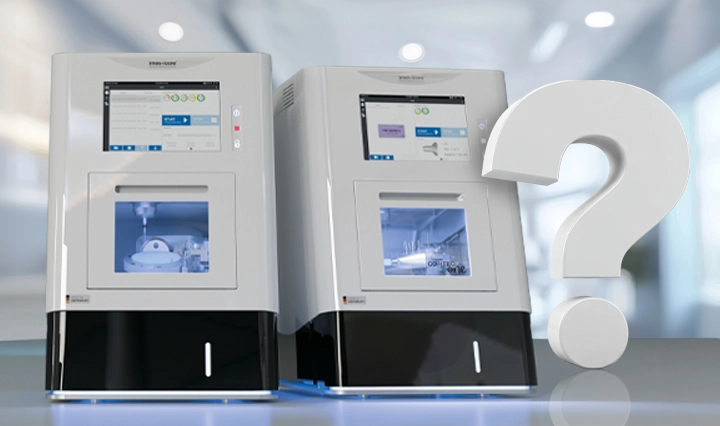
The milling machine manufactures the restoration from materials such as hybrid ceramic, PMMA, or lithium disilicate. Milling times—depending on the material—usually range between 10 and 25 minutes. Additional firing cycles may be necessary for glass-based ceramics. Modern milling units are compact and can be placed in treatment rooms or small side rooms. Investment costs usually fall in the mid-five-figure range, depending on the system and software licenses.
Technological progress in recent years has significantly simplified chairside manufacturing. While early systems required steep learning curves, current studies demonstrate increasing suitability for daily use—particularly thanks to improved scanners, automated design steps, and faster CAM processes.
2. Practical Application / Use Cases
Single Crowns
Single-tooth crowns are among the most common indications in restorative dentistry. They can be reliably produced chairside with good aesthetic results. The economic relevance is high due to their standardizable workflow. According to Gade (2016), single-visit crowns are among the most financially attractive chairside applications.
Inlays, Onlays, Partial Crowns
Minimally invasive restorations particularly benefit from digital manufacturing. Hybrid ceramics allow fast milling without a firing cycle, reducing overall treatment time and enabling same-visit definitive restorations.
Aesthetic Anterior Restorations
Optical properties are crucial in this area. Lithium disilicate remains the material of choice due to its translucency and aesthetics. Chairside use is possible but requires design expertise and precise shade matching.
Temporary Restorations
PMMA restorations can be manufactured quickly and reproducibly chairside, making them ideal for immediate provisionalization. Industrially polymerized PMMA blocks enable high-quality long-term temporaries.
Implant Prosthetics
This field remains largely laboratory-based because many implant-specific components are regulated and technically demanding. Chairside is mainly suitable for temporary or occlusally guided provisional restorations.
3. Benefits for Manufacturing Centers
1. Clinical Benefits
Chairside restorations eliminate temporaries, reduce the number of visits, and minimize potential error sources. Patients benefit from immediate treatment, often perceived as more modern and convenient. According to Decisions in Dentistry (2023), single-visit treatments significantly increase patient acceptance.
2. Efficient Workflow Design
The digital workflow enables precise reproducibility and predictable treatment planning. As no laboratory transfer is required, total treatment time is reduced—also easing appointment scheduling.
3. Economic Efficiency
Profitability depends on treatment volume. Studies show that chairside systems are particularly profitable in practices with a steady flow of restorative cases. Several analyses conclude that investment can pay off within 18–36 months (Gade, 2016; Decisions in Dentistry, 2023).
4. Practice Positioning
A digital workflow strengthens the image of an innovative, patient-focused practice. Many patients value impression-free treatments and fast definitive solutions.
4. Challenges / Limitations
A realistic assessment acknowledges that chairside workflows require structured implementation:
Team Skills & Training
Implementing a chairside workflow changes role distributions. Initial training is essential to safely manage design processes. Stück (2022) notes that modern systems simplify onboarding through automation.
Material-Dependent Process Times
Material choice significantly influences workflow duration.
Cost Calculation & Indication Scope
Practices with very low ceramic restoration volume may see limited economic benefit. Practices with medium to high treatment volume gain substantial advantages.
Quality Assurance
Regular maintenance, calibration, and process checks are needed to ensure consistent quality.
5. Market & Future Perspectives
Studies and market analyses reveal a steadily increasing adoption of chairside CAD/CAM systems. The 2024 cross-sectional study (Quintessence Publishing) shows rising usage especially where patient retention and efficiency are strategic goals.
Technological trends include:
• faster milling processes
• improved material properties, especially hybrid and glass ceramics
• AI-supported design assistants
• open CAD/CAM system architectures for flexible device and material choices
• fully integrated systems coordinating scanner, CAD, CAM, and furnace workflows
These developments indicate that chairside manufacturing will become even easier to integrate into various practice structures in the future.
6. Conclusion & Recommendations
Chairside manufacturing provides a modern, efficient way to deliver high-quality restorations in a single visit. Whether the investment pays off depends primarily on the number of annual single-tooth restorations, organizational structure, and the practice’s readiness for digital integration.
Practices with steady restorative volume, high patient demand for rapid solutions, and a well-structured digital workflow benefit the most. Investment costs are in the mid-five-figure range and—according to several studies—can pay off within a few years.
At the same time, chairside manufacturing complements rather than replaces dental laboratories—especially for complex or implant-supported cases. Careful selection of indications, materials, and workflow steps is essential for success.
FAQ
1. Which practices benefit most from chairside manufacturing?
Practices with regular restorative volume (crowns, inlays, onlays) and an established digital workflow. High patient return rates and frequent single-tooth restorations increase profitability.
2. How much time does a chairside restoration save?
In many cases, the second appointment is eliminated entirely. Hybrid ceramics can be milled in approx. 10–15 minutes, enabling same-visit definitive treatment.
3. Which materials are suitable for chairside use?
Hybrid ceramics for fast, no-firing restorations; lithium disilicate for highly aesthetic cases; PMMA for provisional restorations.
4. How extensive is the training effort?
Lower than in the past, as many steps are automated. Nevertheless, structured team training remains essential.
5. Can the digital workflow be flexibly integrated into a practice?
Yes—especially when responsibilities are clearly defined and milling cycles are scheduled parallel to other treatments.