PEEK (polyetheretherketone) is a semi-crystalline thermoplastic polymer belonging to the polyaryletherketone, or PAEK, family. It was originally developed for demanding industrial applications and has since become established as a biomaterial in medical and dental fields.
One of PEEK's most distinctive properties is its relatively low elastic modulus. Unmodified PEEK typically has an elastic modulus of approximately 3–4 GPa, making it considerably more flexible than metals or zirconia. This characteristic can influence how forces are distributed within a prosthetic structure.
PEEK also offers good chemical resistance, low density and radiolucency. Unlike metals, it does not produce the same degree of imaging artifacts and its low weight can be advantageous for larger removable or implant-supported structures.
At the same time, the material has limitations. Standard PEEK has a grayish or beige appearance and does not provide the translucency of dental ceramics. Its chemically inert and relatively low-energy surface can also make reliable bonding more challenging. Surface conditioning and the correct adhesive system therefore play an important role when PEEK frameworks are veneered or bonded to other materials.
Different modified PEEK materials are available. Fillers such as ceramic particles or fibers can change mechanical properties, stiffness, color and surface behavior. For this reason, PEEK should not be treated as one universally identical material; the specific product and manufacturer instructions remain decisive.

PEEK, PMMA and zirconia can all be integrated into CAD/CAM workflows, but they serve different purposes.
Property | PEEK | PMMA | Zirconia |
| Material type | High-performance thermoplastic | Acrylic polymer | Polycrystalline ceramic |
| Strength | High for a polymer | Moderate | High to very high |
| Elasticity | Relatively flexible | Relatively flexible | Very rigid |
| Weight | Very low | Low | Higher |
| Aesthetics | Limited without veneering | Good, depending on product | Very good to excellent |
| Milling | Good | Very easy | Good in pre-sintered state |
| Post-processing | Finishing, polishing, surface treatment | Finishing and polishing | Sintering |
| Typical applications | Frameworks, selected implant components, splints | Temporaries, dentures, splints, try-ins | Crowns, bridges, full-arch restorations |
PMMA is especially efficient for temporary restorations, dentures and diagnostic applications. It is easy to machine and generally requires minimal post-processing. Its mechanical properties, however, are more limited when high structural loads are involved.
Zirconia represents the opposite end of the spectrum. It provides very high rigidity and strength and is widely used for definitive crowns, bridges and complex restorations. Its ceramic structure also provides significantly better aesthetic possibilities than conventional PEEK.
PEEK occupies a different position. Its combination of toughness, low weight and lower stiffness can be advantageous for selected frameworks and removable prosthetic structures. Reviews of CAD/CAM dental materials describe PEEK particularly as an alternative framework material rather than a direct replacement for zirconia or PMMA across all indications.
Material selection should therefore always begin with the clinical and prosthetic indication rather than with the manufacturing method alone.

PEEK is well suited to subtractive CAD/CAM manufacturing. Industrially produced blanks provide homogeneous material properties and can be processed directly after digital design.
Compared with CoCr, PEEK requires considerably lower cutting forces. However, its thermoplastic behavior introduces a different challenge: heat management.
Milling strategy
PEEK can typically be machined using carbide tools designed for polymer processing. Sharp cutting edges are particularly important because dull tools increase friction and can generate excessive heat.
If too much heat develops at the cutting zone, the polymer can soften locally. This can result in smearing, rough surfaces or material adhering to the tool instead of forming clean chips.
The machining strategy should therefore provide efficient material removal while avoiding unnecessary friction.
As with other CAD/CAM materials, milling normally progresses from larger tools for roughing to smaller tools for detailed geometries and finishing. Feed rates, spindle speed, cutting depth and tool geometry must be coordinated as a complete strategy rather than optimized individually.
Universal numerical parameters should not simply be transferred between systems. The ideal values depend on the specific PEEK material, milling machine, tool geometry and CAM strategy.
Dry or wet milling?
Depending on the PEEK material and CAD/CAM system, processing may be performed dry or according to another manufacturer-approved strategy.
When dry milling is used, effective chip evacuation is important. PEEK produces lightweight polymer chips that must be removed from the machining area to prevent recutting and heat buildup.
The validated recommendations of the material and machine manufacturer should always take priority over generic machining values.
Tool condition
PEEK is less abrasive than ceramics such as zirconia, but tool condition still has a direct influence on machining quality.
A worn cutting edge increases friction and can cause heat-related surface defects. Small tools used for detailed internal geometries are particularly sensitive because they operate in narrow areas where chip evacuation can be more difficult.
Regular tool monitoring therefore contributes both to predictable fit and to consistent surface quality.
Surface treatment as a special challenge
One of the most important differences between PEEK and many other dental materials appears after milling.
The chemically inert surface that gives PEEK its good chemical stability also makes adhesion more demanding. Untreated PEEK generally has relatively poor bonding characteristics. Mechanical pretreatment, primers or other surface-conditioning techniques may therefore be necessary when veneering composites or adhesive bonding are part of the restoration.
The exact procedure depends on the PEEK product and bonding system. Surface treatment should therefore be considered part of the validated restorative workflow rather than an optional finishing step.
PEEK has been investigated for a wide range of dental indications. The strongest practical interest lies in applications that benefit from low weight, toughness and a degree of elasticity.
Frameworks
One of the most established areas of interest is prosthetic frameworks.
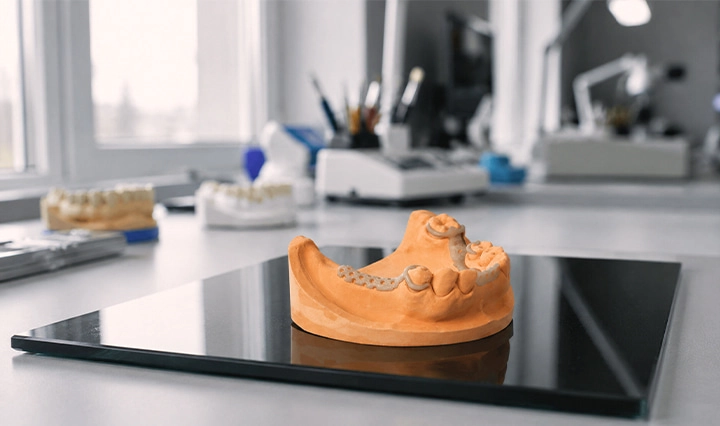
PEEK can be used for selected removable partial denture frameworks, double-crown prostheses and implant-supported structures. Its low density allows relatively lightweight constructions, while CAD/CAM manufacturing enables complex geometries to be produced reproducibly. Research on removable prostheses has reported promising fit and short-term clinical performance for PEEK frameworks, although longer-term evidence remains more limited than for established metal systems.
A PEEK framework is generally not selected for its appearance alone. The polymer is often combined with veneering materials or other restorative components to achieve the desired final aesthetics.
Its lower rigidity compared with metals must also be considered during design. Connector dimensions and framework geometry cannot simply be copied from a CoCr restoration and transferred directly to PEEK.
Implant abutments
PEEK is also used in implant prosthetics, particularly for temporary components, customized healing abutments and selected provisional applications.
A major advantage is its ease of modification and its suitability for shaping an individualized emergence profile during soft-tissue management.
However, PEEK should not automatically be considered a direct replacement for titanium in definitive abutments. Current literature notes limitations in areas such as torque behavior and mechanical performance, and stronger long-term clinical evidence is still required for many definitive implant applications.
This makes the distinction between temporary and definitive use particularly important. Material selection should always follow the approved indication of the specific PEEK product and implant system.
Occlusal splints
PEEK can also be considered for selected occlusal splints and functional appliances.
Its toughness and comparatively low elastic modulus can provide different mechanical behavior from rigid PMMA appliances. CAD/CAM processing allows thickness, occlusal contacts and insertion paths to be digitally defined before milling.
Reviews of digital prosthodontics have identified occlusal splints among the potential CAD/CAM applications for PEEK, although PMMA remains considerably more established for conventional milled splint production.
Whether PEEK provides an advantage therefore depends on the individual indication and required appliance characteristics rather than simply on its higher-performance polymer classification.
The manufacturing process itself follows the same general logic as other subtractive CAD/CAM workflows:
Scan → CAD design → CAM preparation → Milling → Finishing → Surface treatment
What changes is the way the restoration is designed and processed.
The material's elasticity must be considered during CAD design, particularly for frameworks and connector areas. During CAM preparation, a PEEK-specific machining strategy should be selected. After milling, finishing and surface conditioning are adapted to the final application.
Because no sintering or crystallization is required, the production chain can remain relatively short. This is an important advantage compared with ceramic materials.
At the same time, the absence of a thermal post-processing step does not mean that PEEK is automatically simple to use. Precise machining, controlled finishing and appropriate surface treatment are essential to achieving predictable results.

PEEK adds a distinctive material option to digital dental technology. Its low weight, toughness, chemical stability and relatively low elastic modulus differentiate it clearly from PMMA, zirconia and metal alloys.
CAD/CAM milling makes it possible to manufacture PEEK frameworks, selected implant prosthetic components and functional appliances efficiently from industrially produced blanks. The material can be processed without subsequent sintering or crystallization, supporting streamlined digital workflows.
However, PEEK should not be viewed as a universal replacement for established dental materials. Its limited intrinsic aesthetics, demanding bonding behavior and application-specific clinical evidence must be considered carefully.
When the indication, design, machining strategy and surface treatment are coordinated correctly, PEEK can provide dental laboratories with an additional high-performance polymer for specialized CAD/CAM applications.
FAQ:
What is PEEK used for in dentistry?
PEEK is used for selected removable and implant-supported frameworks, temporary and healing abutments, splints and other prosthetic components. Its exact applications depend on the specific material and regulatory approval.
Can PEEK be milled with CAD/CAM?
Yes. PEEK is well suited to subtractive CAD/CAM manufacturing and is available as prefabricated blanks. Suitable tools and material-specific machining strategies should be used.
Is PEEK stronger than PMMA?
PEEK generally offers higher toughness and mechanical performance than conventional PMMA, but the properties vary between specific formulations. The two materials also serve different clinical purposes.
Is PEEK better than zirconia?
Neither material is universally better. Zirconia provides significantly higher rigidity and superior tooth-colored aesthetics, while PEEK offers low weight, toughness and greater flexibility. The appropriate choice depends on the restoration.
Can PEEK be used for implant abutments?
PEEK is used particularly for temporary abutments and customized healing components. Definitive use depends on the specific material and implant system, and current evidence does not support treating PEEK as a universal replacement for titanium abutments.
Does PEEK require special surface treatment?
Often, yes. PEEK has a chemically resistant, low-energy surface that can make adhesive bonding challenging. When bonding or veneering is required, appropriate surface conditioning and a compatible adhesive system should be used.