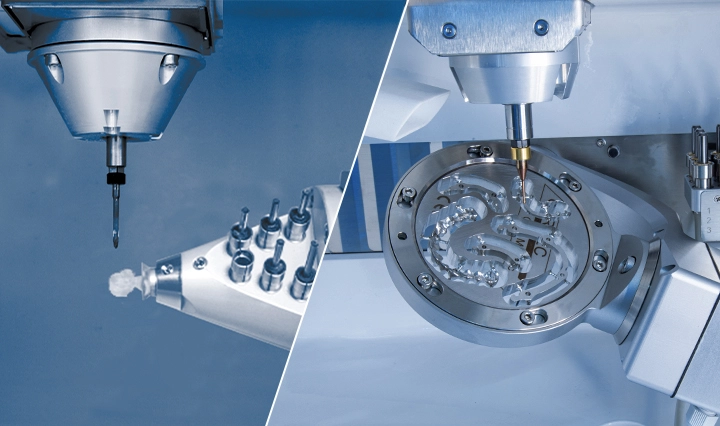
A dental milling machine is a CAD/CAM manufacturing system that converts a digital restoration design into a physical restoration by removing material from a blank or disc using rotating cutting tools.
The milling process typically follows these steps:
Modern dental milling systems can process a wide range of materials, including:
The machine's number of axes directly influences the complexity, precision, and efficiency of the milling process.
What does "axis" mean in dental milling?
An axis refers to a direction of movement that the milling machine can control during machining.
Basic movement axes
Most milling systems operate using:
Additional rotational movements create more flexibility and access to complex geometries.
Why additional axes matter
The more axes a machine can control simultaneously, the easier it becomes to:
This is why the distinction between 4-axis and 5-axis systems is so important.
The primary difference lies in the machine's ability to rotate the restoration during machining.
Comparison Overview
Feature | 4-Axis Milling Machine | 5-Axis Milling Machine |
|---|---|---|
| Movement Axes | 3 linear + 1 rotational | 3 linear + 2 rotational |
| Geometry Complexity | Moderate | High |
| Implant Cases | Limited | Excellent |
| Surface Quality | Good | Excellent |
| Undercut Accessibility | Limited | Extensive |
| Material Flexibility | High | Very High |
| Automation Potential | Moderate | High |
| Investment Cost | Lower | Higher |
For simple restorations, both technologies can produce excellent results. However, as restoration complexity increases, 5-axis systems offer significant advantages.
A 4-axis milling machine combines three linear axes with one rotational axis.
This allows the blank or disc to rotate during machining while the milling tools move around it.
Advantages of 4-axis systems
4-axis machines are often attractive because they offer:
They are particularly well suited for:
For laboratories focusing primarily on conventional restorative cases, a modern 4-axis machine can be a highly efficient solution.
Limitations of 4-axis systems
Certain geometries become challenging because the machine has fewer movement possibilities.
Potential limitations include:
As restoration designs become more sophisticated, these limitations become increasingly relevant.
A 5-axis machine adds a second rotational axis.
This allows the restoration and milling tool to approach the workpiece from multiple angles simultaneously.
The result is significantly greater freedom of movement during machining.
Advantages of 5-axis systems
Modern 5-axis milling systems provide:
These benefits are especially important for:
Simultaneous vs. indexed 5-axis milling
Not all 5-axis systems operate the same way.
Indexed 5-axis
The machine repositions the restoration between machining operations.
Advantages include:
Simultaneous 5-axis
All five axes move continuously during milling.
Advantages include:
For advanced laboratories, simultaneous 5-axis systems often provide the highest level of manufacturing capability.
Not every case requires a full 5-axis workflow.
However, certain restorations benefit significantly from advanced machining capabilities.
Implant restorations
Implant-supported prosthetics often involve:
These designs are ideal candidates for 5-axis machining.
Full-arch restorations
Full-arch zirconia and hybrid prosthetics require:
A 5-axis machine improves manufacturing efficiency and consistency.
Custom abutments
Custom titanium and hybrid abutments frequently contain geometries that are difficult to access with fewer axes.
5-axis systems enable more predictable production.
Complex bridge structures
Large bridge frameworks often benefit from:
Material compatibility should always be a major consideration when purchasing a milling machine.
Common CAD/CAM materials
Material | 4-Axis | 5-Axis |
|---|---|---|
| Zirconia | Excellent | Excellent |
| PMMA | Excellent | Excellent |
| Wax | Excellent | Excellent |
| Composite | Excellent | Excellent |
| Hybrid Ceramic | Good | Excellent |
| Glass Ceramic | Good | Excellent |
| CoCr | Limited to model | Excellent |
| Titanium | Limited | Excellent |
For laboratories planning to expand into implant prosthetics or metal milling, 5-axis systems typically offer greater flexibility.
How to choose the right dental milling machine
Selecting a milling machine should involve more than simply comparing prices.
The most successful investments align with long-term production goals.
Production volume
Start by evaluating your current workload.
Questions to consider:
Higher volumes generally justify more advanced automation and machining capabilities.
Material strategy
Future material requirements matter as much as current needs.
Consider:
A broader material portfolio often favors 5-axis technology.
Automation level
Modern systems increasingly feature:
Automation can significantly increase machine utilization and reduce labor costs.
Open vs. closed systems
Open systems provide flexibility when selecting:
Closed systems often prioritize simplicity but may limit future expansion.
Many laboratories prefer open CAD/CAM ecosystems because they allow greater workflow customization.
Dry milling vs. wet milling
Another important consideration is machining technology.
Dry milling
Common for:
Advantages:
Wet milling
Required for:
Advantages:
Some advanced systems support both wet and dry processing.
The dental industry continues to move toward more complex restorative indications and greater workflow automation.
Several factors drive the growing adoption of 5-axis technology.
Increased restoration complexity
Modern restorative dentistry increasingly involves:
These applications benefit significantly from advanced machining capabilities.
Greater production flexibility
A 5-axis machine can often replace multiple specialized workflows.
Benefits include:
Future-proof investment
Although acquisition costs are higher, many laboratories view 5-axis systems as a long-term strategic investment.
As digital dentistry continues to evolve, advanced machining capabilities become increasingly valuable.
The role of milling machines in the digital dental workflow
A milling machine is only one component of a complete CAD/CAM ecosystem.
Maximum efficiency is achieved when the entire workflow is integrated.
A modern workflow typically includes:
Solutions such as the coritec® milling portfolio combined with icam CAD/CAM software help laboratories and clinics streamline these processes while maintaining high manufacturing quality.
The closer the integration between software and hardware, the more predictable and efficient production becomes.
FAQ
Is a 5-axis dental milling machine better than a 4-axis machine?
Not necessarily for every laboratory. A 5-axis machine offers greater flexibility and can process more complex restorations, while a 4-axis machine may be sufficient for standard crowns, bridges, PMMA, and zirconia production.
Can a 4-axis machine mill zirconia?
Yes. Modern 4-axis systems are highly capable of producing zirconia crowns and bridges with excellent accuracy.
What is the main advantage of 5-axis milling?
The primary advantage is improved accessibility to complex geometries, resulting in greater flexibility, better surface quality, and more efficient machining of implant and full-arch restorations.
Are 5-axis milling machines faster?
In many complex cases, yes. Improved tool access and more efficient toolpaths can reduce machining times and manual intervention.
Which milling machine is best for a dental laboratory?
The best choice depends on production volume, material requirements, implant workload, automation needs, and future growth plans. Laboratories seeking maximum flexibility typically benefit from 5-axis systems.
Conclusion
Choosing between a 4-axis and 5-axis dental milling machine is ultimately a strategic decision. While 4-axis systems remain highly effective for standard restorative workflows, 5-axis technology delivers greater flexibility, broader material compatibility, and superior capabilities for implant and full-arch applications.
For laboratories and clinics investing in long-term digital manufacturing, evaluating production volume, material requirements, automation features, and future growth plans is essential. With the right CAD/CAM ecosystem, a dental milling machine becomes far more than a production tool—it becomes the foundation of a scalable, efficient, and future-ready digital workflow.