1. Technological Background
Titanium remains one of the most widely used materials in implant prosthetics due to its biocompatibility, corrosion resistance, and favorable strength-to-weight ratio. In full-arch restorations, the bar serves as a rigid infrastructure that distributes forces and supports the final prosthesis.
A major success factor in full-arch implant prosthetics is passive fit—minimizing strain on implants, screws, and surrounding tissues. Multi-unit abutment concepts help standardize restorative platforms and improve conditions for screw-retained full-arch constructions.
Compared to traditional casting, digital design + subtractive manufacturing reduces variability:
This is particularly relevant for long-span frameworks where small inaccuracies can accumulate across the arch.
A common high-end approach is a titanium bar infrastructure with a monolithic zirconia suprastructure (or another durable shell) bonded/luted on top. Studies report encouraging short-term clinical results for zirconia suprastructures combined with titanium bars, including low major complication rates in follow-ups around 1+ year.
For serviceability, some teams prefer designs where the shell (e.g., PMMA/composite) is easier to repair or replace—especially for bruxers or immediate-load protocols.
A digital workflow can enable:
This reduces remakes and improves predictability.
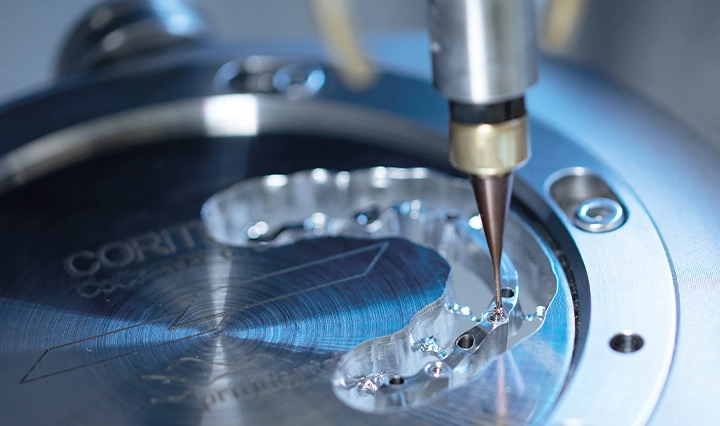
Full-arch bars require stable machining, reliable clamping, and process control—especially in titanium and CoCr indications. imes-icore systems and workflows are designed to cover a broad indication range including implant prosthetics and bar structures, supporting scalable production in labs and milling centers.
Even excellent digital workflows can fail without control points. Typical pitfalls include:
A pragmatic takeaway: full-arch success is rarely about one “perfect” step—it’s about risk management across the chain.
Full-arch implant prosthetics continues to grow, driven by demographics, patient expectations, and expanding treatment concepts. The future direction is clear:
For labs, this means competitive advantage will increasingly come from process reliability and throughput, not just craftsmanship.
CAD/CAM-milled titanium bars have become a practical, evidence-aligned route to predictable full-arch implant prosthetics—especially when paired with standardized restorative concepts like multi-unit abutments and well-controlled finishing protocols.
Recommendations for labs and milling centers:
If you want to expand full-arch implant workflows in-house, a robust CAD/CAM production setup—covering titanium and high-performance materials—becomes a strategic asset for predictable, profitable prosthetics.