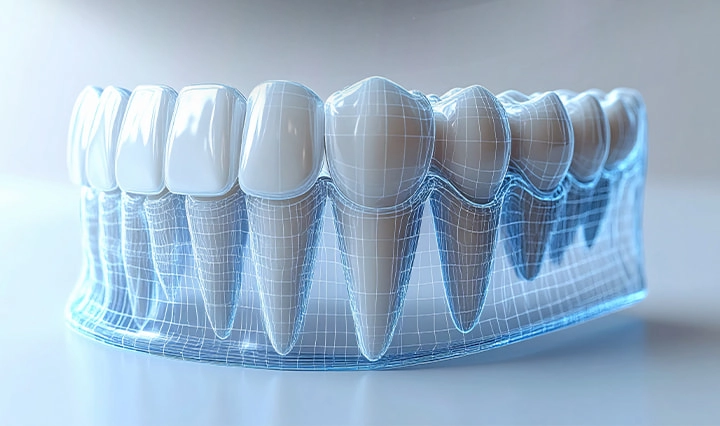
AI is already present in several stages of digital dentistry, particularly in CAD design and data analysis.
Modern dental CAD software can use AI to recognize anatomical structures, segment teeth and generate restoration proposals. Instead of starting every crown from a standard library tooth and adjusting it manually, an algorithm can analyze adjacent and antagonist teeth and suggest a morphology adapted to the individual case.
AI is also being used for tasks such as automatic tooth segmentation and facial-feature recognition in digital smile design. The basic principle is always similar: the software reduces repetitive manual work and provides the technician with a useful starting point.
In manufacturing, the distinction between AI and automation becomes more important. Many CAM functions are already highly automated but are still primarily based on predefined rules. Examples include automatic tool selection, collision checking, rest-material machining and nesting.
The next step is to make these processes more adaptive by using production data to optimize decisions dynamically.

Restoration design is one of the areas where AI can provide immediate time savings.
Traditionally, a dental technician selects an appropriate tooth shape, positions it within the scan and then adjusts contacts, occlusion and morphology manually. Even with advanced CAD software, this requires several individual design decisions.
AI-supported design changes the starting point.
The software can analyze the preparation, adjacent teeth, antagonist and available space before generating an individualized restoration proposal. Instead of building the restoration from scratch, the technician can review and refine an already adapted design.
The workflow therefore changes from:
Select → Position → Adapt → Check
to:
Generate → Check → Refine
This does not mean that the technician simply accepts every automatic proposal. Margin quality, proximal contacts, occlusion, minimum material thickness and aesthetics still need to be evaluated.
The main advantage is that repetitive design work can be reduced. This becomes especially relevant in laboratories with high case volumes, where even small time savings per restoration can add up across hundreds of units.
Human judgment remains essential, however. A technically plausible morphology is not automatically the best aesthetic or functional solution for every patient.

Once a CAD design is complete, the restoration must be positioned within a blank, block or production platform. This process is known as nesting.
Nesting influences material utilization, machining time and overall production efficiency. Modern CAM systems already automate many parts of this process, including positioning, blank management and job selection.
However, automatic nesting is not necessarily AI-based.
A conventional algorithm may simply search for an available space that meets predefined geometric conditions. AI-supported production planning could go further by considering multiple factors at the same time, such as remaining blank material, restoration priority, tool condition, machine availability and delivery deadlines.
Instead of only asking where a restoration fits, the system could determine where and when it should be produced most efficiently.
This is particularly relevant for larger laboratories or milling centers operating several dental milling machines. A zirconia crown, a titanium bar and a lithium disilicate veneer require different materials, tools, machines and post-processing steps.
More intelligent production planning can therefore help assign each case to the most suitable workflow and reduce unnecessary manual coordination.
Quality control is another area with strong potential for machine learning.
In conventional production, many problems are only identified after manufacturing. A technician may notice a damaged margin, poor surface quality or another defect when inspecting the finished restoration.
A more intelligent system could use machine and production data to identify unusual patterns earlier.
Potential applications include the analysis of:
If sufficient production data is available, machine learning could recognize patterns associated with an increased risk of tool failure or manufacturing errors.
This concept is often referred to as predictive maintenance or predictive quality control.
Current CAD/CAM systems already offer functions such as collision monitoring, tool management and predefined machining strategies. These features should not automatically be described as AI. Machine learning goes one step further by using historical data to predict potential problems before a fixed threshold is reached.
Even then, final inspection remains essential. Fit, surface quality and clinical suitability cannot be reduced to a single software decision.
One of the most common concerns surrounding AI is whether automation will eventually replace dental technicians.
In practice, the more likely development is a shift in responsibilities.
Routine steps such as basic morphology generation, nesting or production scheduling can increasingly be automated. This reduces the amount of repetitive work technicians need to perform manually.
At the same time, technical judgment becomes even more important.
Someone still needs to determine whether an automatically generated restoration makes sense. A technician must understand occlusion, morphology, materials and manufacturing limitations in order to identify when a software proposal needs adjustment.
The role therefore moves from pure execution toward supervision, optimization and decision-making.
This is particularly important in complex cases. AI may be able to generate an effective standard crown design, but full-arch restorations, implant cases and highly aesthetic anterior restorations involve decisions that depend on experience, clinical information and individual patient requirements.
The technician also remains responsible for understanding the manufacturing process. Selecting an unsuitable material or ignoring minimum dimensions cannot be compensated for simply because an AI system was involved in the design.
Automation therefore creates the greatest value when it handles predictable routine work while technicians focus on complex cases and final quality.

For imes-icore, the development toward AI begins with a highly connected and increasingly automated CAD/CAM workflow.
Current iCAM solutions already provide many of the building blocks required for intelligent production. Depending on the software and machine configuration, these include automated workflows, optimized machining strategies, job management, collision monitoring and guided operation.
It is important to distinguish these functions from AI itself. A validated milling strategy or automated loader is primarily an automation technology.
However, these systems create the digital infrastructure on which more intelligent workflows can be built.
The greater opportunity lies in connecting design, CAM, machines, materials and production data more closely. A future workflow could combine an AI-supported restoration proposal with automated CAM preparation, intelligent job assignment and predictive machine monitoring.
In this scenario, the objective is not one isolated “AI feature.” The real value comes from making the complete digital workflow more connected and adaptive.
For dental laboratories, this could mean fewer manual interventions, more consistent production and better use of available machine capacity.
Artificial intelligence is beginning to change dental CAD/CAM workflows, but its impact should be viewed as part of a broader development toward automation and connected production.
AI-supported CAD design can already generate patient-specific restoration proposals, while automated nesting and production management reduce repetitive CAM tasks. Machine learning could further improve quality control by identifying patterns associated with tool wear or manufacturing problems before they result in failed restorations.
The dental technician remains central to this process. AI can generate suggestions and automate routine decisions, but professional expertise is still required to evaluate function, aesthetics, materials and clinical requirements.
For imes-icore, current automated CAM workflows, integrated machine technology and production management provide an important foundation for this development.
The future of the dental laboratory is therefore unlikely to be simply AI instead of technicians. It is much more likely to be technicians working with increasingly intelligent digital production systems.
FAQ:
How is AI currently used in dental technology?
AI is already used for applications such as tooth segmentation, restoration design proposals, smile design and analysis of digital patient data. In CAD/CAM manufacturing, many production steps are automated, while more advanced AI-driven planning and predictive functions continue to develop.
Can AI automatically design dental crowns?
Yes. Current dental CAD solutions can generate AI-supported crown design proposals based on patient anatomy, adjacent teeth and occlusion. The technician can then review and modify the proposed design before manufacturing.
Is automatic nesting the same as AI?
No. Automatic nesting can operate using predefined algorithms and rules without artificial intelligence. AI-based nesting can potentially use additional production data to optimize factors such as material utilization, production time and machine capacity.
Can AI detect milling errors?
Machine learning has the potential to detect patterns associated with tool wear, machine deviations or manufacturing problems. Current CAD/CAM systems already provide monitoring functions, while predictive AI-based quality control is still developing.
Will AI replace dental technicians?
AI is more likely to change the technician's role than eliminate it. Routine tasks can increasingly be automated, while expertise in aesthetics, function, material selection, complex design and final quality control remains essential.
How is imes-icore preparing for AI-driven workflows?
imes-icore already provides automated CAM workflows, optimized machining strategies, job management and machine monitoring within its digital ecosystem. These connected processes provide the technical basis for increasingly intelligent production workflows.