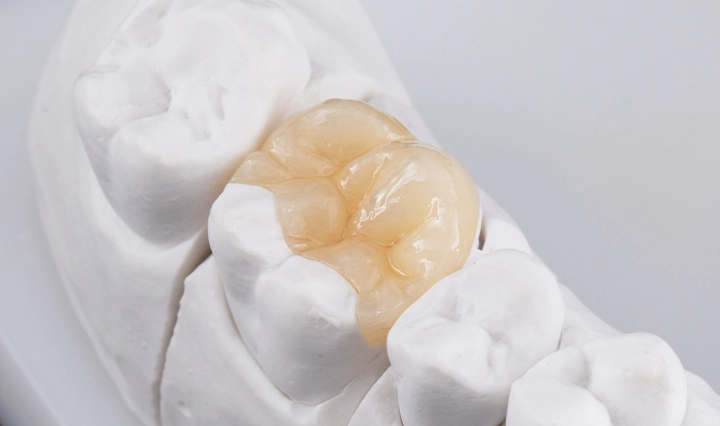
A dental onlay is an indirect restoration used to repair teeth with moderate structural damage that is too extensive for a filling but does not yet require a full crown. Unlike traditional fillings, onlays are fabricated outside the mouth — often using CAD/CAM technology — and bonded to the prepared tooth.
An onlay typically covers one or more cusps of the tooth while preserving as much healthy enamel and dentin as possible. Because of this conservative approach, onlays are often referred to as “partial crowns.”
Dental onlays are commonly indicated for:
Modern onlays can be fabricated from ceramic, zirconia, composite or metal alloys and are frequently produced with digital CAD/CAM systems.

Although inlays, onlays and crowns are all indirect restorations, they differ significantly in coverage, preparation design and clinical indication.
Restoration Type | Coverage | Typical Indication | Common Materials | Tooth Reduction |
| Inlay | Fits within cusps only | Small to moderate defects | Ceramic, composite, gold | Minimal |
| Onlay | Covers one or more cusps | Moderate structural loss | Ceramic, zirconia, composite, metal | Conservative |
| Crown | Covers entire clinical crown | Extensive damage or weakened tooth | Zirconia, ceramic, metal-ceramic | Highest |
Inlays
Inlays are conservative restorations that fit inside the cusps of a tooth. They are suitable when the damage is limited to the central chewing surface and cusp coverage is unnecessary.
Onlays
Onlays extend over one or multiple cusps and provide additional structural reinforcement. They preserve more healthy tooth structure than crowns while offering greater protection than inlays.
Crowns
Crowns fully encase the tooth and are indicated when extensive destruction, severe fractures or major weakening are present. While crowns offer maximum protection, they also require the greatest amount of tooth reduction.
For many modern restorative cases, onlays represent the ideal balance between conservation and durability.
Different materials and manufacturing techniques allow dental professionals to select the most suitable onlay for each clinical situation.
Ceramic onlays (Lithium Disilicate & Zirconia)
Ceramic onlays are among the most widely used restorations in modern digital dentistry because of their excellent aesthetics, biocompatibility and compatibility with CAD/CAM systems.
Lithium Disilicate (LiDi)
Lithium disilicate ceramics are highly aesthetic glass ceramics known for their translucency and natural tooth-like appearance. They are especially suitable for:
Advantages include:
Lithium disilicate is frequently used in chairside workflows because it can be milled quickly and crystallized efficiently.
Zirconia onlays
Zirconia offers exceptional flexural strength and fracture resistance, making it ideal for high-load posterior restorations.
Modern multilayer zirconia materials also provide improved translucency compared to earlier generations.
Advantages include:
Zirconia onlays are often selected for molars and patients with heavy occlusal forces.
Metal onlays (Gold & CoCr)
Although less common today, metal onlays remain clinically relevant in certain indications.
Gold onlays
Gold has historically been considered one of the most durable restorative materials in dentistry.
Advantages include:
However, patient demand for tooth-colored restorations has reduced the popularity of gold onlays.
CoCr onlays
Cobalt-chromium (CoCr) alloys may still be used in specific clinical situations requiring high strength and cost efficiency.
Advantages include:
Limitations include lower aesthetics and more limited acceptance in visible regions.
Composite onlays
Composite onlays provide a conservative and cost-effective restorative solution.
Modern CAD/CAM composite blocks offer improved mechanical properties compared to conventional direct composites.
Advantages include:
Composite onlays are often chosen for:
However, composites generally show lower long-term wear resistance than ceramics.
Selecting the right onlay material depends on multiple factors including mechanical load, esthetics, preparation geometry, adhesive strategy and manufacturing method.
| Material | Strength | Aesthetics | CAD/CAM Millability | Relative Cost |
| Lithium Disilicate | High | Excellent | Excellent | Medium-High |
| Zirconia | Very High | Good-Very Good | Excellent | Medium |
| Composite | Moderate | Good | Very Good | Medium |
| Gold | Very High | Low | Limited digital use | High |
| CoCr | High | Low | Good | Low-Medium |
Choosing lithium disilicate
Lithium disilicate is often the preferred solution when aesthetics are the primary concern and adhesive bonding is possible.
Ideal indications include:
Choosing zirconia
Zirconia is preferred when maximum strength is required.
Typical indications include:
Modern translucent zirconia materials now allow improved aesthetics while maintaining excellent durability.
Choosing composite
Composite CAD/CAM blocks are useful for conservative and economical restorations.
They may be advantageous in:
Choosing metal restorations
Metal onlays are primarily selected based on longevity and functional durability rather than aesthetics.
Although less common today, they continue to provide excellent clinical performance in selected cases.
Successful CAD/CAM onlays require preparation designs optimized for digital scanning, milling precision and material-specific requirements.
Preparation geometry has a direct impact on:
Recommended wall thicknesses
Minimum wall thickness depends on the selected material.
| Material | Occlusal Thickness | Axial Thickness |
| Lithium Disilicate | 1.0–1.5 mm | 1.0 mm |
| Zirconia | 0.8–1.0 mm | 0.6–0.8 mm |
| Composite | 1.0–1.5 mm | 0.8–1.0 mm |
Insufficient thickness may lead to:
Margin design
CAD/CAM restorations benefit from smooth and clearly defined preparation margins.
Recommended designs include:
Sharp internal angles can increase stress concentration and reduce milling precision.
Occlusal reduction
Adequate occlusal reduction is essential for material strength and proper anatomy.
Reduction should:
Divergence angle
Preparations should generally provide:
This improves both digital scanning quality and restoration seating.
Digital scanning considerations
For optimal intraoral scanning results:
Well-designed preparations simplify both CAD design and CAM manufacturing.
Digital dentistry has fundamentally transformed how onlays are designed and manufactured.
Traditional workflows involving physical impressions, stone models and manual waxing are increasingly replaced by fully digital CAD/CAM systems.
Modern workflows offer:
Digital workflow overview
A typical CAD/CAM onlay workflow includes:
Chairside manufacturing advantages
Chairside CAD/CAM systems allow clinicians to fabricate restorations in a single appointment.
Benefits include:
coritec ONE chairside workflow
The modern chairside workflow can be efficiently realized using the coritec ONE ecosystem.
Step 1: Digital scan
The workflow begins with an intraoral scan that captures the prepared tooth and surrounding anatomy.
Digital impressions improve patient comfort and provide highly precise data for CAD design.
Step 2: CAD design with icam
The restoration is designed digitally using CAD software such as icam.
The software enables:
Step 3: CAM strategy and milling
After design approval, the restoration is transferred to the milling unit.
Modern milling systems provide:
The coritec ONE system enables compact and efficient chairside manufacturing for clinics and laboratories.
Step 4: Finishing and insertion
Depending on the material, the restoration may require:
The onlay is then adhesively bonded or conventionally cemented according to the selected material and clinical protocol.
The shift toward digital dentistry continues to accelerate worldwide.
Several factors contribute to the growing popularity of CAD/CAM onlays:
Minimally invasive treatment
Onlays preserve significantly more healthy tooth structure compared to full crowns.
This aligns with modern minimally invasive dentistry concepts.
Material innovation
Advanced ceramics and hybrid materials provide improved:
Workflow efficiency
Digital workflows reduce manual labor and improve consistency.
Clinics and laboratories benefit from:
Improved patient experience
Patients increasingly prefer:
Chairside CAD/CAM solutions support these expectations effectively.
FAQ
How long do dental onlays last?
Dental onlays can last 10–20 years or longer depending on material selection, oral hygiene, occlusal conditions and adhesive protocol. Ceramic and gold onlays generally demonstrate the highest long-term durability.
Is an onlay better than a crown?
An onlay is often considered more conservative because it preserves more natural tooth structure. Crowns may still be necessary for severely weakened or extensively damaged teeth.
Can onlays be milled chairside?
Yes. Modern CAD/CAM systems allow ceramic and composite onlays to be digitally designed and milled chairside within a single appointment.
Which material is best for posterior onlays?
The ideal material depends on clinical requirements. Zirconia is preferred for maximum strength, while lithium disilicate offers superior aesthetics and adhesive performance.
Are CAD/CAM onlays accurate?
Modern CAD/CAM systems provide highly precise restorations with excellent marginal adaptation and reproducible manufacturing quality.