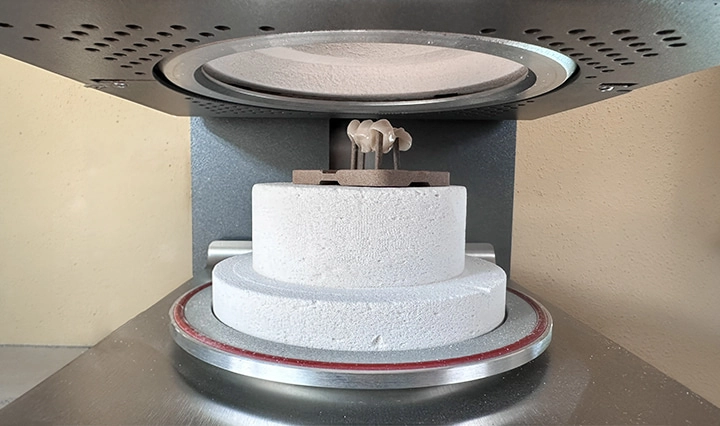
A dental sintering furnace is a specialized high-temperature device used to thermally process dental materials after CAD/CAM manufacturing. Its primary purpose is to transform a milled or shaped restoration into its final dense, strong and clinically usable state.
Many dental materials are milled in a partially processed condition. For example, zirconia restorations are typically milled from pre-sintered blanks, often referred to as "green-state" zirconia. In this stage, the material is relatively soft and easy to machine.
After milling, the restoration must be heated to extremely high temperatures—often above 1,450°C—to achieve full density and mechanical strength.
Why is sintering necessary?
Sintering creates microscopic changes within the material structure that significantly improve performance.
Benefits include:
Without proper sintering, zirconia restorations would remain too weak for clinical use.
The role of sintering in CAD/CAM workflows
A typical zirconia workflow includes:
The sintering stage acts as the bridge between digital manufacturing and final restoration performance.

Understanding the terminology
Depending on region, manufacturer and industry background, professionals may use different terms:
In practical terms, these devices perform the same essential task: controlled thermal processing of dental restorations.
Why "furnace" is preferred
The term "furnace" is generally favored because modern dental units operate at extremely high temperatures and use sophisticated heating technologies, including:
These capabilities align more closely with industrial furnace technology than conventional ovens.
Not all furnaces are designed for the same materials or production environments.
Zirconia sintering furnaces
These are the most common units found in modern CAD/CAM laboratories.
Key characteristics:
Applications include:
Speed sintering furnaces
Speed sintering technology significantly reduces processing times.
Benefits include:
Depending on material compatibility, some restorations can be sintered in less than two hours.
Metal sintering furnaces
Certain furnaces are designed for metal-based additive manufacturing and specialized alloy processing.
These systems may support:
Metal sintering often requires different environmental conditions compared with zirconia processing.
Hybrid or multi-material furnaces
Some modern systems support multiple materials and workflows.
Advantages include:
Laboratories with diverse production requirements often benefit from these systems.
Different materials require specific sintering temperatures, holding times and heating profiles.
The exact values always depend on the material manufacturer's recommendations, but the following table provides a general overview.
Material | Typical Temperature | Approximate Duration | Typical Program |
|---|---|---|---|
| Zirconia | 1,450–1,600°C | 4–12 hours | Standard or speed sintering |
| CoCr (metal sintering applications) | 1,250–1,400°C | 2–8 hours | Controlled atmosphere program |
| Press Ceramic (post-press heat treatment)* | 700–1,000°C | 20–90 minutes | Crystallization or glazing cycle |
*Press ceramics are generally processed differently than zirconia and do not undergo traditional zirconia-style sintering.
Zirconia sintering
Zirconia requires the highest temperatures among common dental restorative materials.
During sintering:
Modern CAD software automatically compensates for expected shrinkage during the design process.
CoCr processing
Cobalt-chromium restorations may require specialized thermal treatment depending on manufacturing technique.
Important considerations include:
Ceramic crystallization cycles
Lithium disilicate and similar glass ceramics typically undergo crystallization rather than traditional sintering.
These cycles improve:
Always follow manufacturer-specific processing instructions.
Selecting a dental sintering furnace requires balancing current production needs with future growth plans.
The cheapest option is not always the most cost-effective investment.
Capacity
Capacity determines how many restorations can be processed simultaneously.
Questions to consider:
Small clinics may prioritize compact systems, while laboratories often require larger chambers and higher throughput.
Automation
Modern furnaces increasingly feature advanced automation.
Useful features include:
Automation reduces operator workload and minimizes process variability.
Material compatibility
Not every furnace supports every material.
Before purchasing, verify compatibility with:
Material flexibility helps protect long-term investments.
Temperature performance
A furnace should provide:
Temperature consistency directly affects restoration quality.
Speed sintering capability
For laboratories and clinics seeking faster turnaround, speed sintering functionality can be highly valuable.
Potential benefits include:
However, compatibility between speed programs and selected zirconia materials must always be verified.
User interface and software
Modern dental laboratories increasingly value intuitive operation.
Look for:
User-friendly systems reduce training requirements and operator errors.
Service and support
Long-term reliability depends heavily on manufacturer support.
Important considerations include:
Downtime can quickly become more expensive than the initial purchase price difference.
Even high-quality furnaces can produce poor results if processing parameters are incorrect.
Overloading the chamber
Excessive loading may cause:
Incorrect material programs
Using the wrong cycle can lead to:
Poor maintenance
Regular maintenance is essential for:
Ignoring maintenance can significantly shorten furnace lifespan.
Mixing incompatible workflows
Materials requiring different thermal environments should only be processed according to manufacturer recommendations.
Always verify compatibility before combining workflows.
As CAD/CAM dentistry continues to evolve, expectations for restoration quality continue to rise.
Today's laboratories require:
Modern sintering furnaces support these goals by combining precise thermal control with intelligent automation.
When integrated into a complete digital workflow—from scanning and CAD design to milling and thermal processing—they help ensure that restorations meet the highest standards for fit, strength and aesthetics.
FAQ
What temperature is used for zirconia sintering?
Most zirconia restorations are sintered between 1,450°C and 1,600°C, depending on the material manufacturer and specific zirconia type.
How long does dental sintering take?
Traditional zirconia sintering cycles typically require 4–12 hours. Modern speed-sintering programs can significantly reduce processing times, sometimes to less than two hours.
Can CoCr and zirconia be processed in the same furnace?
Not always. While some advanced systems support multiple materials, CoCr processing may require different thermal environments and program settings. Always verify compatibility with the furnace and material manufacturer.
Does every CAD/CAM restoration require sintering?
No. Zirconia requires sintering, while some glass ceramics undergo crystallization cycles instead. Composite restorations generally do not require sintering.
What is the advantage of speed sintering?
Speed sintering reduces turnaround times, supports same-day dentistry and improves workflow efficiency while maintaining material properties when approved by the material manufacturer.
Conclusion
Dental sintering furnaces are a critical component of modern CAD/CAM dentistry. They transform milled restorations into durable, clinically reliable prosthetics by applying precisely controlled thermal processes. Whether producing zirconia crowns, implant restorations or specialized metal frameworks, selecting the right furnace can significantly impact productivity, restoration quality and long-term profitability.
By evaluating capacity, automation, material compatibility and temperature performance, dental laboratories and clinics can choose a solution that supports both current workflows and future growth.