Zur Hauptnavigation springen Zum Inhalt springen

Closed-Loop Quality Assurance in Digital Dentistry: Building a Predictable CAD/CAM Workflow from Scan to Final Fit

| Workflow, Digital dentistry

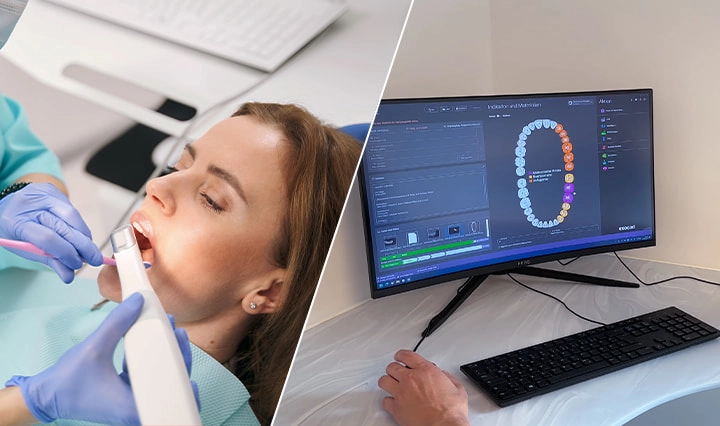
Digital dentistry has made dental production faster and more scalable—but speed is only valuable when results are predictable. Remakes, chairside adjustments, and “mystery misfits” often come from the same root cause: missing quality gates between the individual workflow steps.


A closed-loop workflow turns a linear process chain (scan → design → mill → deliver) into a controlled system with feedback: data is checked, manufacturing is monitored, and results are verified—so errors are caught early, not at delivery. This article explains how to build closed-loop quality assurance into everyday CAD/CAM production, whether you are a dental practice, a laboratory, or a high-volume milling center.

1. Technological background

1.1 What “closed-loop” means in CAD/CAM dentistry

In manufacturing, a closed-loop system uses measurement + feedback to keep processes stable. In dentistry, that translates into:

  • Input validation (Is the scan usable? Are margins/implant positions reliable?)
  • Design rule checks (Are thicknesses, connectors, emergence profiles, and offsets within safe limits?)
  • Manufacturing control (Are tools, machine calibration, and CAM strategies appropriate for the material and indication?)
  • Output verification (Does the restoration match the design and intended fit?)

Instead of hoping that every step went well, closed-loop workflows prove it—with defined checkpoints and standardized documentation.

1.2 Where quality issues actually originate

Most quality failures are not “random.” They are systematic and often repeatable:

  • Data problems: incomplete scans, distorted stitch areas, noisy margins, wrong bite registration
  • Design problems: under-dimensioned connectors, unrealistic insertion axes, missing relief, unsupported thin walls
  • CAM problems: unsuitable milling strategy for the material, wrong tool choice, excessive tool wear, poor nesting
  • Machine/process problems: calibration drift, spindle/runout issues, coolant/air problems, clamping errors
  • Human handoff problems: unclear case instructions, missing shade/material/implant library info, version confusion

Closed-loop QA doesn’t remove complexity—but it reduces uncertainty and makes outcomes consistent.

1.3 The digital thread: traceability as the foundation

Quality assurance becomes easier when every case has a clear “digital thread”:

  • patient/case ID
  • scan file and version
  • CAD file + settings
  • CAM job + tool list + strategy
  • machine + date/time + operator
  • material batch + indication
  • post-process steps (sintering, staining, bonding, polishing)
  • final inspection result

This type of traceability is not just for large milling centers. Even small labs benefit because it turns troubleshooting into a quick, evidence-based process.

2. Practical applications / use cases

2.1 A closed-loop workflow for crowns and bridges (lab or milling center)

Checkpoint 1 – Scan intake

  • Verify scan completeness (margins, proximal surfaces, occlusal anatomy)
  • Confirm bite and articulation quality
  • Standardize naming and case notes (material, shade, cementation type)

Checkpoint 2 – CAD rule check

  • Minimum thickness and margin integrity
  • Connector sizing (especially posterior bridges)
  • Occlusal contacts: “light” vs “strong” contact strategy depending on indication
  • Cement space/offset settings aligned with the material and clinical preference

Checkpoint 3 – CAM & nesting validation

  • Correct blank/disc selection
  • Orientation for strength and aesthetics (zirconia translucency zones, connector direction, etc.)
  • Support pin placement that won’t damage critical surfaces
  • Tool path simulation (collision risk, fragile areas)

Checkpoint 4 – Production monitoring

  • Tool wear rules (replace tools by hours/units, not “when it sounds bad”)
  • Machine calibration routine (scheduled checks rather than reactive fixes)
  • Document deviations (e.g., unusual chipping, surface issues)

Checkpoint 5 – Output inspection

  • Visual and tactile inspection of margins and intaglio
  • Fit verification on model (or digital comparison if used)
  • Surface integrity check before staining/glazing/bonding

Result: fewer remakes, fewer chairside adjustments, more predictable turnaround times.

2.2 Closed-loop workflow for implant restorations (abutments, bars, full-arch)

Implant prosthetics is where closed-loop QA pays off fastest—because small errors can become big chairside problems.

Key additions:

  • Library validation (implant system, scan body, Ti-base geometry, screw channels)
  • Angulation and insertion checks for multi-unit situations
  • Passive fit strategy for full-arch bars (design rules + manufacturing precision + verification)
  • Tight traceability of components (Ti-base batch, screw type, torque protocol notes)

For full-arch cases, closed-loop QA is the difference between “fits first try” and “hours of adjustments.”

2.3 Chairside workflows: quality gates without slowing down

In a practice, time is the main constraint. Closed-loop QA must be simple:

  • quick scan checklist (capture margin + interprox + bite reliably)
  • standardized CAD presets per indication and material
  • machine readiness routine (calibration check schedule, bur life tracking)
  • quick post-mill inspection and finishing protocol

A chairside workflow becomes truly profitable when it produces same-day restorations with confidence, not same-day stress.

3. Benefits for target groups

3.1 Dental practices

  • More predictable appointments (less chairside grinding and rework)
  • Higher patient satisfaction (better fit, fewer follow-ups)
  • Better team training (checklists reduce “tribal knowledge”)
  • Clear positioning as a modern digital practice

3.2 Dental laboratories

  • Fewer remakes and fewer emergency cases
  • More stable quality across technicians (standardized gates)
  • Higher throughput because you stop firefighting
  • Easier onboarding for new staff

3.3 Milling centers / production environments

  • Scalability with consistent quality
  • Lower unit costs through reduced scrap and repeat work
  • Traceability that supports audits, customer trust, and process optimization
  • Better machine utilization by preventing avoidable downtime

4. Challenges

4.1 “Quality gates will slow us down”

Initially, yes—slightly. But closed-loop QA usually speeds up the total system because it prevents high-cost interruptions later (remakes, rush jobs, troubleshooting calls).

A good rule:
Add the smallest possible checkpoint at the earliest possible stage.
Catching a scan problem in 30 seconds beats discovering a fit problem after milling.

4.2 Standardization vs. flexibility

Dental work is case-specific, but many parameters should not be reinvented each time. The solution is to standardize:

  • material-based CAM strategies
  • indication-based CAD presets
  • inspection criteria and documentation
    …and keep flexibility for anatomy and clinical requirements.

4.3 Data interoperability and handoffs

Cases often pass through multiple systems (scanner → CAD → CAM → machine). Version mismatch, file naming chaos, and unclear instructions can break the workflow.

Fixes that work:

  • consistent naming conventions
  • “minimum information” intake form (material, shade, margin type, implant system, due date)
  • controlled presets and approved libraries

4.4 Equipment discipline: calibration and tool lifecycle

Even the best software cannot compensate for:

  • dull tools
  • inaccurate calibration
  • unstable clamping
  • incorrect material handling (e.g., zirconia sintering deviations)

Closed-loop QA turns these from “mystery problems” into routine maintenance and documented standards.

5. Market and future prospects

5.1 The shift from craftsmanship to process engineering

Digital dentistry is moving toward industrial thinking: reliable processes, measurable outcomes, and scalable production. The winners will be teams that treat workflows like systems, not like individual heroics.

5.2 AI-assisted quality checks

Expect more automated detection of:

  • scan defects (missing areas, margin uncertainty)
  • risky CAD geometries (thin zones, connector weakness)
  • CAM collision risks and inefficient toolpaths
  • early warning signals from machine data (predictive maintenance)

5.3 Automation as the natural extension of closed-loop QA

Automation works best when the process is stable. Closed-loop QA provides the stability—and enables:

  • unattended production
  • standardized tool management
  • consistent quality at volume

For users running advanced milling solutions (from compact chairside units to high-capacity production machines), closed-loop QA is the backbone that makes automation financially meaningful.

6. Conclusion & recommendations

A digital workflow becomes truly “digital” when it is predictable—and predictability comes from feedback. Closed-loop quality assurance transforms CAD/CAM from a fast process chain into a controlled system.

Practical recommendations you can implement immediately

  1. Create a scan intake checklist (1 minute per case, maximum impact).
  2. Lock in CAD presets per material and indication (stop redesigning your process each time).
  3. Standardize CAM strategies and define tool change rules.
  4. Schedule machine calibration checks instead of waiting for errors.
  5. Add one output inspection step before delivery (and document it).

Where imes-icore fits into this workflow approach (soft product hint)

If your goal is consistent, scalable production, choose a CAD/CAM environment that supports process reliability, repeatability, and clean handoffs—and milling systems that are designed for stable long-term performance. imes-icore’s CORiTEC solutions and CAM ecosystem are commonly positioned exactly around that idea: turning digital workflows into dependable production routines—whether chairside, in the lab, or in a milling center.