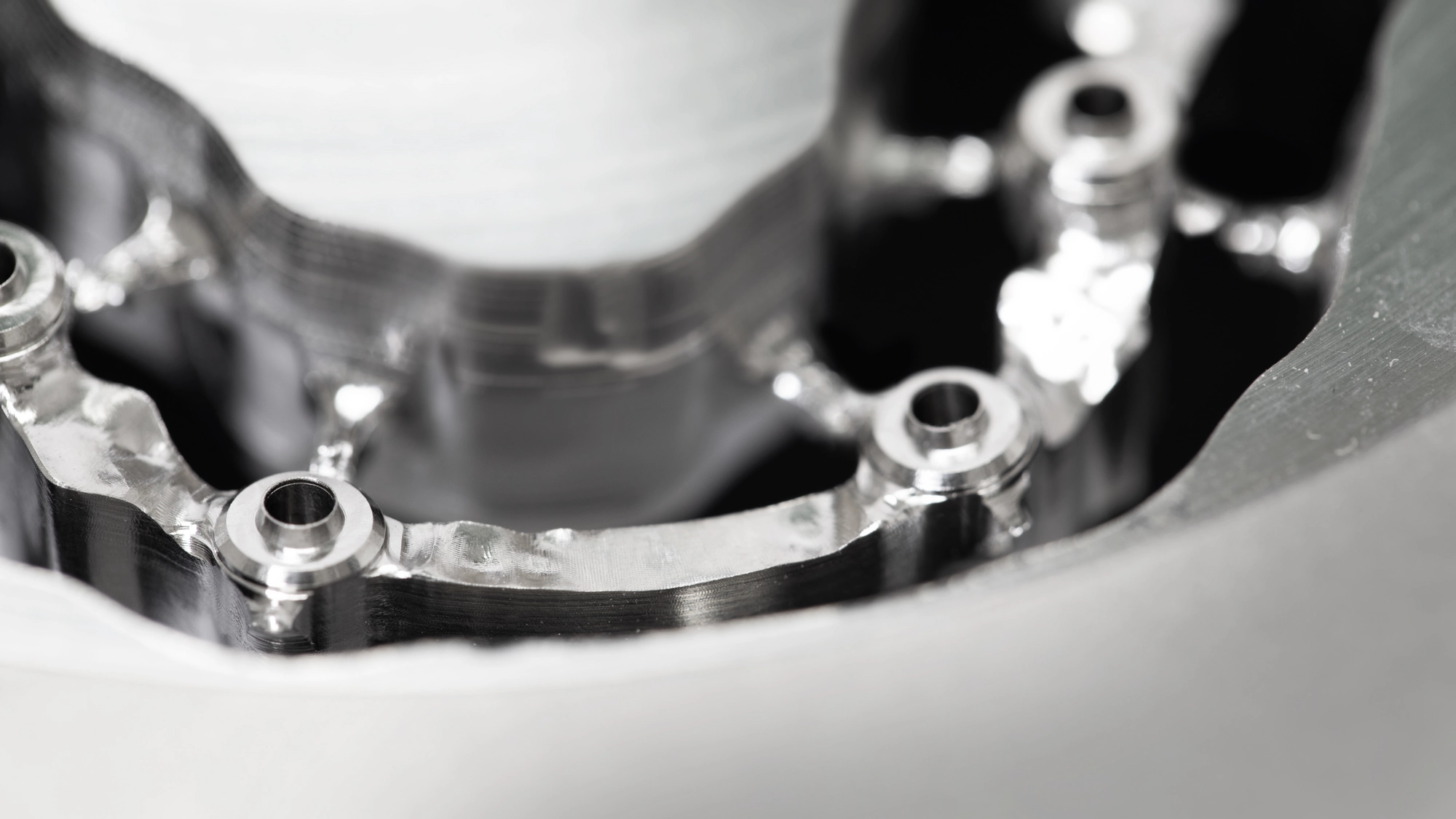
Cobalt-chromium, commonly abbreviated as CoCr, is a metal alloy primarily consisting of cobalt and chromium, with additional alloying elements depending on the specific material.
Cobalt provides high mechanical strength and rigidity, while chromium contributes to corrosion resistance by forming a protective oxide layer on the material surface. This combination makes CoCr suitable for long-term use in the oral environment.
In dental technology, one of its main advantages is its ability to create thin yet mechanically stable structures. This is particularly useful for frameworks, bars and other restorations where limited space is available but high strength is required.
Compared with precious-metal alloys, CoCr is also relatively cost-effective. The material itself, however, is challenging to machine. Its hardness and mechanical properties generate considerable forces and heat at the cutting edge, making a stable CAD/CAM system and suitable milling tools essential.

CoCr is only one of several high-performance materials used in modern dental CAD/CAM workflows. Zirconia and titanium are also widely used, but each material has different strengths.
Property | CoCr | Zirconia | Titanium |
|---|---|---|---|
| Strength | Very high | Very high | High |
| Biocompatibility | Very good | Excellent | Excellent |
| Aesthetics | Low – metallic appearance | Excellent – tooth-colored | Low – metallic appearance |
| Material cost | Relatively low | Moderate | Moderate to high |
| Millability | Demanding | Good in pre-sintered state | Demanding |
| Typical use | Frameworks, bars, telescopic restorations | Crowns, bridges, frameworks | Abutments, bars, implant restorations |
Zirconia is particularly attractive when aesthetics are important. Because it is milled in a pre-sintered state, machining is also considerably different from processing a fully dense metal.
Titanium combines excellent biocompatibility with a favorable strength-to-weight ratio and is particularly important in implant prosthetics. Like CoCr, however, it places high demands on machining.
CoCr remains especially interesting when high rigidity, strength and economic material use are required. The ideal material therefore depends on the indication rather than on one material being universally superior.

Direct milling of CoCr requires a different approach from machining softer materials such as PMMA or wax. Because of the material's hardness, the interaction between machine, CAM strategy and cutting tool becomes particularly important.
The process generally starts with roughing, during which larger tools remove most of the material efficiently. Subsequent finishing operations use smaller tools to create detailed geometries, margins and precise surfaces.
A stable machine construction helps minimize vibration during this process. This is particularly important for CoCr, as uncontrolled vibration can negatively affect surface quality, tool wear and dimensional accuracy.
Tool selection is equally critical. Cutting-edge geometry and coating must be designed to withstand the mechanical and thermal loads generated during metal machining. A tool developed for zirconia or PMMA, for example, should not simply be transferred to a CoCr workflow.
Modern CAM solutions such as iCAM V5 provide predefined milling strategies for different materials and applications. Instead of manually applying universal spindle speeds or feed rates, the machining strategy can therefore be coordinated with the specific machine, tool and material combination.
Dry milling and cooling
CoCr can be processed using dry milling strategies on suitable dental CAD/CAM systems. Dry machining eliminates the need for liquid coolant during the actual milling process and can simplify material handling and machine cleaning.
This makes efficient chip evacuation especially important. The milling chamber and extraction system must remove metal chips reliably and prevent excessive accumulation around the tool and workpiece.
Depending on the machine, application and selected workflow, other machining concepts may also be possible. The decisive factor is always to follow the validated process for the specific combination of CoCr material, machine, tools and CAM strategy rather than applying general machining values.
The mechanical properties of cobalt-chromium make it suitable for a wide range of dental restorations, particularly where stability and rigidity are essential.
Frameworks
CoCr has traditionally been used for removable partial denture frameworks and remains an important material for digitally manufactured frameworks. Its high rigidity allows relatively thin structures to provide the mechanical stability required for long-term function.
CAD/CAM manufacturing adds the advantage of digital design and reproducibility. Framework dimensions, connectors and other design elements can be defined virtually before the restoration is milled from a CoCr blank.
Telescopic crowns
CoCr is also widely used for telescopic crowns and prostheses. These restorations require precisely coordinated primary and secondary components, making manufacturing accuracy particularly important.
The rigidity and wear resistance of CoCr make it suitable for these demanding functional surfaces, while CAD/CAM manufacturing enables the required geometries to be produced with a high degree of reproducibility.
Bars
In implant prosthetics, CoCr can be used for bar constructions that connect several implants and provide a stable foundation for removable restorations.
These structures often combine complex geometries with demanding fit requirements. Digital design and multi-axis milling therefore provide significant advantages when producing implant-supported bars.
Removable prostheses
CoCr can also form the structural basis of removable prostheses. Its strength allows frameworks to remain relatively thin while providing the rigidity required for clasps, connectors and support structures.
The result is a material that remains highly relevant even as dental laboratories increasingly move from conventional manufacturing toward fully digital workflows.
Efficient CoCr machining depends not only on the milling machine and CAM strategy but also on the tool that directly interacts with the material.
The IronBiter milling tools were developed specifically for CoCr processing. Their optimized cutting-edge geometry, substrate and coating are designed to address the high mechanical and thermal loads generated during metal milling.
A key feature is the TINox coating, which provides high heat resistance and supports efficient material removal. Compared with the previous Quattro Speed T61 tool, the IronBiter generation enables significantly faster machining while being designed for extended tool life.
The IronBiter family includes different tool diameters for the individual stages of CoCr processing. This allows roughing and finer machining operations to be coordinated within the overall milling strategy.
Combined with a stable CORiTEC milling machine and predefined iCAM V5 strategies, specialized CoCr tools form part of an integrated workflow in which software, machine and tooling are matched to the demands of hard-metal processing.
For dental laboratories that regularly manufacture CoCr restorations, this coordination is particularly important: higher material removal rates are only useful when precision, surface quality and predictable tool performance can be maintained throughout the process.

Cobalt-chromium remains one of the most important high-performance materials in dental technology. Its high strength, rigidity, corrosion resistance and economic material costs make it particularly suitable for frameworks, telescopic restorations, bars and removable prostheses.
At the same time, CoCr is a demanding material to machine. Successful CAD/CAM processing therefore requires more than simply selecting the correct blank. Machine stability, CAM strategy, tool geometry and chip evacuation must work together as part of a coordinated process.
Modern CAD/CAM systems make this increasingly efficient. With dedicated milling strategies and specialized tools such as the IronBiter, dental laboratories can integrate CoCr into a digital manufacturing workflow while maintaining the precision required for complex restorations.
FAQ
Can cobalt-chromium be milled dry?
Yes. CoCr can be dry milled with dental CAD/CAM systems designed for metal processing. The machine, extraction system, tools and CAM strategy must be suitable for the material and the selected workflow.
Why is CoCr difficult to mill?
CoCr is a hard and highly resistant alloy. Machining generates significant mechanical and thermal loads at the cutting edge, which increases the demands placed on machine stability, cutting tools and milling strategies.
What dental restorations can be made from CoCr?
Typical applications include removable denture frameworks, telescopic crowns, bars and other prosthetic frameworks where high strength and rigidity are required.
Is CoCr better than zirconia?
The materials serve different requirements. CoCr offers very high rigidity and is well suited to frameworks and functional structures, while zirconia provides tooth-colored aesthetics and is widely used for crowns and bridges. Material selection should therefore be based on the indication and restorative requirements.
Which tools are suitable for CoCr milling?
Tools specifically designed for hard-metal processing should be used. Dedicated CoCr milling tools such as the IronBiter feature cutting geometries and coatings developed to withstand the mechanical and thermal demands of cobalt-chromium machining.