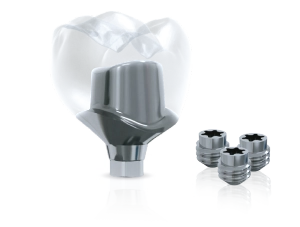
A dental abutment is the connecting component between a dental implant and the prosthetic restoration. The implant is anchored in the jawbone, while the abutment extends above the implant platform and provides the foundation for a crown, bridge or other prosthetic structure.
Depending on the implant system and restorative concept, the abutment can be connected to the implant with a screw or form part of another implant-specific connection. The final restoration can then be cemented or screw-retained according to the selected prosthetic workflow.
The geometry of the abutment plays an important role in the final restoration. Its height, angulation and emergence profile influence the available restorative space and the transition from the implant to the surrounding soft tissue.
Standardized abutments provide an efficient solution for straightforward cases. When implant position, soft-tissue anatomy or aesthetic requirements make a standardized geometry less suitable, a custom CAD/CAM abutment can be designed specifically for the individual situation.

Abutments can be classified according to their design, manufacturing method and prosthetic function. The appropriate option depends on factors such as implant position, available space and the type of final restoration.
Abutment type | Characteristics | Typical application |
| Stock abutment | Prefabricated in standardized shapes and sizes | Straightforward cases with favorable implant positioning |
| Custom abutment | Individually designed for the patient | Aesthetic cases, individual emergence profiles, limited prosthetic space |
| Angled abutment | Corrects the restorative axis relative to implant position | Implants placed at an angle or with challenging prosthetic access |
| Screw-retained solution | Restoration is connected through a screw-access channel | Retrievable restorations and selected implant-supported crowns or bridges |
Stock abutments are prefabricated by the manufacturer and available in defined diameters, heights and emergence profiles. They provide a straightforward and economical solution when the implant position and surrounding anatomy correspond well to the available geometry.
Custom abutments are designed individually using CAD software. This allows the technician to adapt the emergence profile, height and restorative geometry to the specific patient situation.
Angled abutments can compensate for differences between the implant axis and the desired prosthetic orientation. This can be useful when anatomical limitations prevent ideal implant positioning.
Screw-retained concepts provide another approach. Instead of cementing the final restoration, the prosthetic component can be secured through a screw-access channel. This allows the restoration to be retrieved if necessary, although the feasibility depends on implant position and prosthetic design.

Material selection influences mechanical stability, aesthetics, biocompatibility and manufacturing. Three important materials in modern implant prosthetics are titanium, zirconia and PEEK.
Titanium
Titanium is one of the most established materials for dental abutments. Its high strength, excellent biocompatibility and corrosion resistance make it particularly suitable for the direct connection to dental implants.
Titanium can also be processed digitally. Prefabricated titanium blanks or pre-milled abutment blanks can be machined to create individualized geometries while maintaining an accurately manufactured implant connection.
Its main limitation is aesthetic. The metallic color can become visible through thin peri-implant soft tissue, particularly in the anterior region.
Zirconia
Zirconia provides a tooth-colored alternative and is therefore especially attractive for aesthetic implant restorations. Its light color can reduce the risk of a gray appearance through thin gingival tissue.
Zirconia can be efficiently processed with CAD/CAM technology in its pre-sintered state. Depending on the restorative concept, zirconia components may be combined with a titanium base rather than forming the direct implant interface themselves.
This combines the aesthetic advantages of zirconia with a precisely manufactured titanium connection.
PEEK
PEEK (polyetheretherketone) is a high-performance polymer with low weight, good biocompatibility and favorable mechanical properties. In implant dentistry, it can be used for selected temporary or prosthetic components.
Compared with titanium and zirconia, PEEK has a significantly lower elastic modulus. Its indications and long-term suitability therefore depend strongly on the specific product and restorative concept.
Material | Main advantages | Considerations |
| Titanium | High strength, excellent biocompatibility, established implant connection | Metallic appearance |
| Zirconia | Tooth-colored, aesthetic, biocompatible | Brittle compared with metal; often combined with titanium base |
| PEEK | Lightweight, metal-free, easy to machine | More limited definitive indications depending on system |
One of the main advantages of digital implant prosthetics is the ability to manufacture patient-specific abutments instead of adapting the restoration to a standardized component.
The workflow begins with the digital capture of the implant position. A scanbody is connected to the implant or laboratory analog and scanned using an intraoral or laboratory scanner. Its known geometry allows the CAD software to determine the exact position and orientation of the implant connection.
The custom abutment is then designed according to the clinical and prosthetic requirements. Parameters such as emergence profile, abutment height, angulation and the space available for the final restoration can be adapted individually.
Once the design has been completed, the manufacturing data is transferred to the CAM environment.
Manufacturing with the iCAM Abutment Module
The iCAM Abutment Module provides a dedicated workflow for manufacturing individual abutments from pre-milled blanks.
Unlike conventional round blanks, pre-milled abutment blanks already contain the industrially manufactured implant connection. The milling process therefore focuses primarily on creating the patient-specific external geometry of the abutment.
Within the CAM workflow, the appropriate blank and implant interface are assigned to the restoration. The software calculates the machining strategy and positions the component so that the individual abutment geometry can be manufactured efficiently.
A typical workflow can be summarized as:
Scanbody scan → CAD design → iCAM Abutment Module → Pre-milled blank → Milling → Finishing → Quality control
This approach combines two important requirements: an accurately prefabricated implant interface and an individually manufactured prosthetic geometry.
Suitable CORiTEC milling systems can process pre-milled abutment blanks using dedicated holders and machining strategies. Depending on the system and workflow, titanium abutments can therefore be manufactured efficiently without having to mill the complete implant connection from a conventional metal blank.
After milling, the abutment is carefully finished and inspected. Particular attention should be paid to the implant interface, screw channel and prosthetic surfaces. The prefabricated connection itself should not be modified during finishing.
There is no single abutment design that is ideal for every implant restoration. Selection should consider implant position, soft-tissue conditions, restorative space, aesthetics and the planned prosthetic solution.
A stock titanium abutment can be an efficient choice when the implant is ideally positioned and the available prefabricated geometry corresponds well to the restoration.
A custom abutment becomes particularly useful when the emergence profile or restorative geometry needs to be adapted to the individual patient. This can provide greater design flexibility in the aesthetic zone or in situations with limited prosthetic space.
For anterior restorations with thin soft tissue, zirconia or hybrid zirconia-titanium solutions can provide aesthetic advantages by reducing the influence of a metallic abutment color.
When the implant axis differs from the desired prosthetic orientation, an angled solution may help compensate for the position. However, the permitted angulation and screw-access geometry always depend on the specific implant and restorative system.
Ultimately, the abutment should not be selected in isolation. Implant, abutment and final restoration form a connected prosthetic system, and all three components must be considered during treatment planning.

Dental abutments form the critical connection between an implant and the final prosthetic restoration. Stock, custom, angled and screw-retained solutions provide different options depending on the implant position and restorative requirements.
Titanium remains an established choice because of its strength and biocompatibility, while zirconia provides aesthetic advantages and PEEK can offer an alternative for selected applications.
CAD/CAM manufacturing adds another level of flexibility. With patient-specific design, pre-milled blanks and dedicated workflows such as the iCAM Abutment Module, laboratories can manufacture individualized abutments while maintaining a precisely prefabricated implant interface.
The result is a digital workflow that combines standardized implant connections with individualized prosthetic design.
FAQ
What is the difference between a stock and custom abutment?
A stock abutment is supplied in a standardized geometry, while a custom abutment is designed specifically for the individual patient. Custom solutions allow parameters such as emergence profile, height and restorative geometry to be adapted to the clinical situation.
Which material is best for a dental abutment?
There is no universal best material. Titanium offers high strength and an established implant interface, while zirconia can provide aesthetic advantages. PEEK is suitable for selected applications depending on the specific restorative system.
Can titanium abutments be milled with CAD/CAM?
Yes. Custom titanium abutments can be produced using CAD/CAM workflows. Pre-milled blanks are particularly efficient because the implant interface is already industrially manufactured while the individual external geometry is milled by the dental laboratory.
What is a pre-milled abutment blank?
A pre-milled blank is a prefabricated metal blank that already contains the precise connection to a specific implant system. The dental milling machine creates the patient-specific abutment geometry while leaving the prefabricated implant interface intact.
Why use a custom abutment?
Custom abutments provide greater control over emergence profile, angulation, restorative space and the shape of the final restoration. They are particularly useful when standardized abutments do not provide an optimal prosthetic geometry.