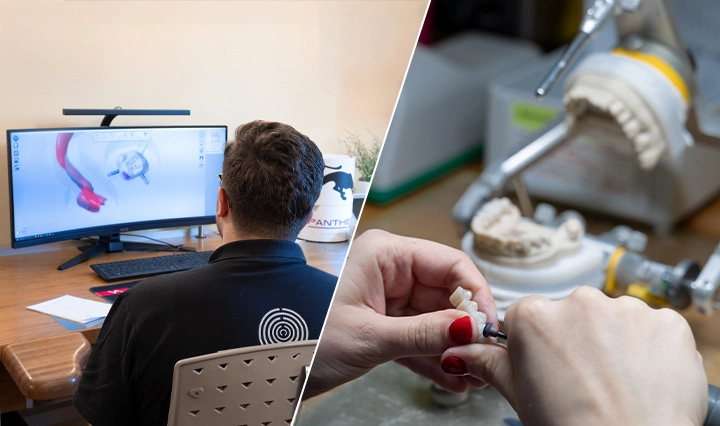
CAD/CAM stands for:
Together, these technologies enable dental restorations to be digitally designed and automatically manufactured.
CAD: The digital design process
The CAD component is responsible for creating the restoration virtually.
Using specialized dental software, technicians or clinicians can design:
The software converts scan data into a three-dimensional digital model and provides tools for designing highly accurate restorations.
Modern systems such as icam CAD software support:
The result is a digital restoration ready for manufacturing.
CAM: The manufacturing process
Once the design is complete, CAM software generates the machining strategy.
The software determines:
The restoration is then produced automatically by a milling machine such as a coritec® CAD/CAM system.
The combination of CAD and CAM creates a seamless digital workflow from design to production.
Several factors have driven the widespread adoption of CAD/CAM technology in dental laboratories.
Growing demand for efficiency
Patients increasingly expect:
CAD/CAM technology supports these expectations while improving production efficiency.
Improved manufacturing precision
Digital workflows eliminate many variables associated with traditional methods.
Benefits include:
Expanding material options
Modern CAD/CAM systems can process numerous materials with different clinical indications.
This flexibility allows laboratories to offer a broader range of restorations while maintaining efficient workflows.
The CAD/CAM workflow consists of several interconnected stages that transform patient data into a finished restoration.
Step 1: Digital scanning
Every digital workflow begins with data acquisition.
This may be performed using:
The scanner captures the patient's dentition and creates a precise digital model.
Compared with conventional impressions, digital scanning offers:
The resulting file serves as the foundation for restoration design.
Step 2: Restoration design with icam
The scan data is imported into CAD software such as icam.
Here, the restoration is designed digitally.
Typical CAD functions include:
The software allows technicians to efficiently create highly detailed restorations while maintaining control over every design parameter.
Step 3: CAM strategy generation
After design approval, the restoration moves to the CAM stage.
CAM software converts the design into machine-readable instructions.
The software calculates:
Optimized CAM strategies help improve:
Step 4: Manufacturing with coritec
The finalized CAM file is transferred to the milling machine.
Modern systems such as the coritec® milling platform automatically manufacture the restoration from a selected material blank or disc.
Depending on the machine and material, production may involve:
The milling process transforms the digital design into a physical restoration.
Step 5: Finishing and post-processing
After milling, additional processing may be required.
Examples include:
The required finishing process depends on the selected material.
Step 6: Clinical delivery
The final restoration is inspected, finished and prepared for insertion.
The completed workflow provides a restoration that combines:
Recommended graphic
For the published article, a workflow graphic is highly recommended:
Digital Workflow:
Scan → icam CAD Design → CAM Strategy → coritec Milling → Sintering/Finishing → Final Restoration
This visual significantly improves reader engagement and supports SEO through enhanced content quality.
One of the greatest advantages of modern CAD/CAM systems is their ability to process a wide range of dental materials.
Each material offers unique properties and clinical indications.
Zirconia
Zirconia has become one of the most important materials in modern restorative dentistry.
Advantages include:
Typical indications:
After milling, zirconia requires sintering to achieve its final properties.
Lithium Disilicate (LiDi)
Lithium disilicate is a glass ceramic known for its outstanding aesthetics.
Advantages include:
Typical indications:
After milling, lithium disilicate requires crystallization firing.
CoCr (Cobalt-Chromium)
CoCr remains a valuable material for certain restorative applications.
Advantages include:
Typical indications:
Many modern milling systems can process CoCr discs efficiently.
PMMA
PMMA is widely used for temporary restorations and laboratory applications.
Advantages include:
Applications include:
PEEK
PEEK is a high-performance polymer increasingly used in digital dentistry.
Advantages include:
Applications include:
As material science advances, CAD/CAM systems continue to support new and innovative materials.
One of the most important decisions when implementing CAD/CAM technology is determining whether production should occur chairside or in the dental laboratory.
The answer depends on workflow requirements, production volume and business objectives.
Chairside manufacturing
Chairside systems allow clinicians to design and produce restorations directly within the practice.
A typical example is the coritec ONE workflow.
Advantages include:
Chairside systems are particularly suitable for:
Laboratory production
Dental laboratories generally operate larger and more versatile manufacturing systems.
Examples include:
Advantages include:
Laboratory systems are designed for:
Comparison overview
Factor | Chairside (coritec ONE) | Laboratory (350i / 650i) |
|---|---|---|
| Production Volume | Low-Medium | Medium-High |
| Same-Day Restorations | Excellent | Limited |
| Automation | Moderate | High |
| Material Range | Moderate | Extensive |
| Implant Cases | Good | Excellent |
| Full-Arch Restorations | Limited | Excellent |
| Investment Size | Lower | Higher |
For many organizations, chairside and laboratory workflows complement rather than replace each other.
While traditional workflows remain clinically effective, digital dentistry offers several significant advantages.
Improved accuracy
Digital workflows reduce manual variables and improve consistency.
Benefits include:
Faster production
Digital manufacturing dramatically reduces production times.
Advantages include:
Reproducibility
Digital data can be stored indefinitely and reproduced when needed.
This allows:
Enhanced communication
Digital workflows facilitate collaboration between:
Files can be transferred instantly without physical shipping.
Scalability
As production demands increase, digital workflows can be expanded more easily than conventional manufacturing methods.
Additional scanners, software licenses and milling systems can be integrated into existing workflows.
Digital dentistry continues to evolve rapidly.
Current trends include:
As technology advances, CAD/CAM systems will become even more efficient, precise and accessible.
Laboratories and practices investing in digital workflows today position themselves for long-term competitiveness and growth.
FAQ
What does a CAD/CAM milling machine cost?
Costs vary depending on machine size, automation level and capabilities. Entry-level systems may start in the lower five-figure range, while advanced laboratory systems with automation can represent significantly larger investments.
Which software do I need for CAD/CAM dentistry?
A complete workflow typically requires CAD software for restoration design and CAM software for manufacturing strategy generation. Integrated solutions such as icam help streamline both processes.
Can all dental materials be milled?
No. While many materials can be milled, each requires specific processing parameters. Common CAD/CAM materials include zirconia, lithium disilicate, PMMA, PEEK, composite materials, titanium and CoCr.
Is CAD/CAM more accurate than conventional methods?
In many cases, digital workflows provide greater consistency, improved reproducibility and highly precise restorations compared to traditional analog techniques.
Can small laboratories benefit from CAD/CAM?
Yes. Modern CAD/CAM systems are available for a wide range of laboratory sizes and production requirements, from compact solutions to fully automated industrial workflows.
Conclusion
CAD/CAM technology has become the foundation of modern dental manufacturing. By combining digital design, intelligent CAM strategies and advanced milling systems, laboratories and practices can produce highly accurate restorations faster and more consistently than ever before.
Whether implemented as a chairside workflow with the coritec ONE or as a high-capacity laboratory solution with the coritec 350i or 650i, CAD/CAM technology delivers measurable advantages in efficiency, precision and scalability. As digital dentistry continues to advance, CAD/CAM workflows will remain a key driver of innovation and competitiveness for dental laboratories worldwide.