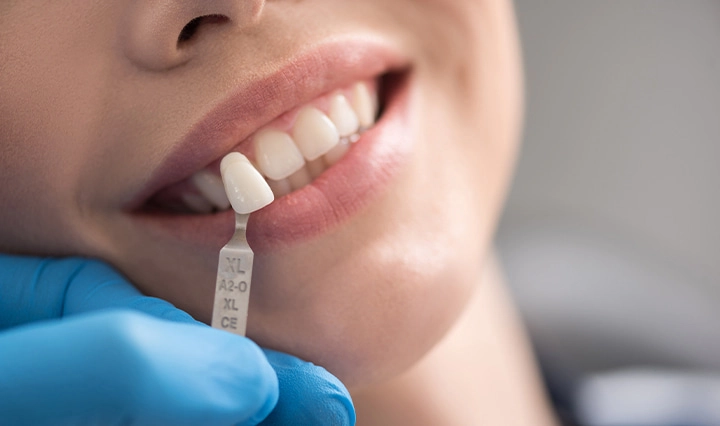
Lithium disilicate is a glass-ceramic whose appeal lies in its balance of optical and mechanical properties. Compared with more opaque high-strength ceramics, it offers a more enamel-like appearance and favorable translucency, which is why it remains highly attractive for esthetically demanding anterior and premolar restorations. At the same time, modern CAD/CAM variants are designed for digital production and can be integrated into streamlined milling workflows.
From a workflow perspective, lithium disilicate is attractive because it supports precision machining and predictable finishing steps. For many users, that means a practical middle ground between highly translucent but lower-strength materials and very strong but less lifelike alternatives. In digital production, this positioning matters: the material is not just chosen for beauty, but for how well it fits the full chain from design to milling to characterization.
In daily practice, lithium disilicate is particularly well suited for:
This makes it highly relevant for practices that want premium esthetics and for laboratories that need a versatile ceramic covering a large share of monolithic restorations. In chairside and labside environments alike, lithium disilicate is valuable when the restoration must look natural, require efficient digital processing, and remain economically viable.
For milling centers, the material is especially interesting in cases where customers demand a visible esthetic upgrade over more opaque solutions. In these cases, digital consistency becomes a competitive advantage: good material quality, stable CAM strategies, and coordinated tooling help reduce adjustment effort and improve reproducibility. That is exactly where a well-matched ecosystem of machine, tool, and validated material workflow becomes strategically important—an area where imes-icore can credibly position its own CAD/CAM solutions.
For dental practices: lithium disilicate offers an excellent option when patient expectations focus on lifelike esthetics, especially in the smile zone. The material’s optical behavior helps clinicians deliver restorations that blend more naturally into surrounding dentition.
For dental laboratories: it expands the portfolio for premium monolithic restorations and supports efficient digital manufacturing. Labs benefit when they can standardize indications, preparation rules, and finishing protocols across repeatable CAD/CAM workflows.
For milling centers: lithium disilicate can be a high-value offering because it serves esthetic cases that need dependable fit and high surface quality. When combined with stable milling performance and validated CAM parameters, it helps reduce remakes and support consistent results across customers. This aligns well with the value proposition of industrial-grade dental milling systems and coordinated material strategies.
Lithium disilicate is not a universal substitute for every ceramic. Its strength profile is very favorable for many indications, but not identical to zirconia, so indication management remains essential. Connector dimensions, span length, preparation design, and occlusal loading all matter. In other words, great results depend not only on the material itself, but on respecting its validated clinical window.
Another challenge is process discipline. Esthetic materials are often judged more critically because minor issues in shade, translucency, fit, or edge quality are immediately visible. That means users need a coordinated workflow—from CAD design and material selection to tooling, milling strategy, crystallization/firing, and finishing. The more precisely these steps are aligned, the more predictable the final restoration becomes.
The market trend clearly favors restorations that combine metal-free esthetics, digital efficiency, and reproducible quality. Lithium disilicate remains highly relevant because it addresses all three. While zirconia continues to dominate many strength-driven indications, lithium disilicate keeps its position where natural appearance and refined esthetics are the priority. Recent survival and performance reviews also support the broader clinical confidence around CAD/CAM ceramic restorations, including lithium disilicate in well-selected cases.
Looking ahead, the most promising development is not the material alone, but the optimization of the full workflow around it. Users increasingly expect validated material libraries, consistent CAM presets, stable milling behavior, and efficient production logic. That trend favors system providers who can connect materials, software, tools, and machines in one practical ecosystem. For imes-icore, this creates a strong editorial bridge: the future of esthetic materials is closely linked to the quality of the production platform behind them.
Lithium disilicate is one of the most convincing materials for digital dentistry when esthetics, precision, and workflow efficiency need to work together. It is not the answer to every indication, but for veneers, inlays, onlays, and many single crowns it remains one of the most attractive choices in the CAD/CAM portfolio.
For laboratories, practices, and milling centers, the recommendation is clear: treat lithium disilicate not simply as a ceramic, but as part of a complete digital production concept. The real advantage appears when the material is paired with reliable machine technology, stable CAM strategies, and coordinated tools. That is where modern dental manufacturing turns material quality into measurable workflow quality—and where imes-icore solutions can be positioned naturally and credibly.
1. What is lithium disilicate?
Lithium disilicate is a highly esthetic glass-ceramic used in digital dentistry for premium restorations. It offers natural optical properties, reliable strength, and excellent suitability for CAD/CAM workflows.
2. Which indications is lithium disilicate suitable for?
Lithium disilicate is commonly used for veneers, inlays, onlays, and anterior as well as posterior crowns. Depending on the system and approved indication range, it may also be used for selected multi-unit restorations.
3. Why is lithium disilicate especially attractive for esthetic restorations?
The material offers high translucency and a natural tooth-like appearance. This makes it particularly suitable for visible areas where lifelike esthetics are essential.
4. What are the benefits of lithium disilicate in a digital CAD/CAM workflow?
Lithium disilicate can be digitally designed with precision and processed efficiently. When combined with coordinated milling strategies, tools, and machines, it enables reproducible results with high esthetic quality.
5. Is lithium disilicate as strong as zirconia?
Not in every indication. Lithium disilicate provides very good strength for many single-tooth restorations, but it is not automatically the best choice for highly stressed or long-span cases. Material selection should always depend on the indication.
6. Who benefits most from this material?
Dental practices, laboratories, and milling centers that want to deliver esthetic, metal-free, and digitally efficient restorations benefit particularly from lithium disilicate.
7. What are the main processing challenges?
Key factors include indication-based design, adequate material thickness, reliable process steps, and a well-coordinated workflow. With highly esthetic materials, precision and process stability are especially important.
8. Why is milling technology so important for lithium disilicate?
Because the final result depends not only on the material itself, but also on the machine, tool, CAM strategy, and process parameters. A coordinated system reduces rework and improves consistency.
9. When should lithium disilicate be chosen over another material?
It is an excellent choice when esthetics, natural translucency, and premium monolithic restorations are the main priorities. For cases with very high functional loads, other materials may be more suitable.
10. Why does this topic fit well with imes-icore?
Because modern materials only reach their full potential when processed within a precise digital manufacturing workflow. This is exactly where imes-icore supports laboratories, practices, and milling centers with coordinated CAD/CAM solutions.