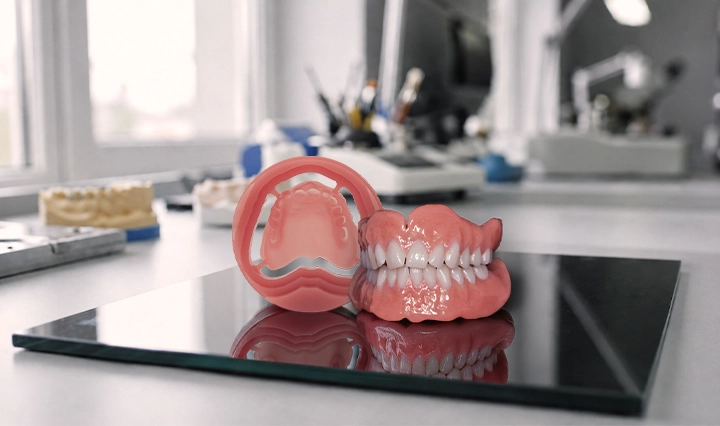
PMMA (polymethyl methacrylate) is a thermoplastic polymer that has been used in dental technology for decades. Traditional applications include denture bases and temporary restorations, but CAD/CAM manufacturing has significantly expanded its range of uses.
One of the main differences between conventional and CAD/CAM PMMA lies in the manufacturing process. CAD/CAM blanks are industrially polymerized under controlled conditions. This results in a homogeneous material structure with predictable mechanical properties and avoids the polymerization shrinkage associated with manually processed acrylic resins.
PMMA also offers good machinability. It can be milled quickly, requires no sintering or crystallization after machining and can usually be finished and polished directly.
Depending on the product, PMMA blanks are available in tooth-colored, gingiva-colored, transparent or multilayer variants. This allows laboratories to use the same material class for very different indications.

PMMA, zirconia, cobalt-chromium and PEEK can all be processed digitally, but their properties and typical applications differ significantly.
Property | PMMA | Zirconia | CoCr | PEEK |
| Material type | Polymer | Ceramic | Metal alloy | High-performance polymer |
| Strength | Moderate | High to very high | Very high | High |
| Aesthetics | Good to very good | Very good to excellent | Low without veneering | Limited to moderate |
| Milling | Easy | Easy in pre-sintered state | Demanding | Good |
| Post-processing | Finishing/polishing | Sintering | Finishing/polishing | Finishing/polishing |
| Typical applications | Temporaries, dentures, splints, try-ins | Crowns, bridges, full-arch | Frameworks, bars, telescopic restorations | Frameworks, selected prosthetic applications |
| Material cost | Relatively low | Moderate | Moderate | Higher |
The biggest advantage of PMMA is its combination of easy processing and versatility. Unlike zirconia, it does not require a high-temperature sintering process after milling. Compared with CoCr, considerably lower cutting forces are required.
Zirconia offers significantly higher strength and is therefore suitable for definitive crowns and bridges, but requires sintering after milling.
CoCr provides very high rigidity and mechanical stability for frameworks and other demanding prosthetic structures. However, milling hard metal places significantly greater demands on the machine and tools.
PEEK is another polymer option with high toughness and low weight. It can be an attractive choice for selected applications but has different aesthetic and bonding characteristics from PMMA.
The appropriate material therefore depends primarily on whether the restoration is temporary or definitive, the mechanical requirements and the desired aesthetics.

PMMA is considered one of the easier dental materials to machine, but achieving high-quality surfaces still requires an appropriate milling strategy.
The most important challenge is heat generation. PMMA has a relatively low thermal resistance compared with ceramics and metals. Excessive heat during milling can soften the material, causing it to smear around the cutting edge or negatively affect surface quality.
Sharp tools and suitable cutting parameters are therefore particularly important.
Milling strategy
PMMA is commonly processed using dry milling, although the appropriate workflow depends on the specific material and milling system.
The machining process usually begins with roughing, during which larger tools efficiently remove the majority of the material. Smaller tools are then used for finishing margins, fissures, internal surfaces and detailed geometries.
Because PMMA is comparatively soft, high material removal rates are possible. However, simply increasing spindle speed or feed rate does not automatically improve efficiency. The parameters must be coordinated so that chips are removed cleanly without generating unnecessary heat.
For this reason, material-specific CAM strategies should be used rather than applying universal parameters.
Tools for PMMA milling
Carbide milling tools are commonly used for PMMA. The cutting geometry should support efficient chip evacuation and produce a clean surface without excessive friction.
Tool condition is also important. Although PMMA causes less abrasive wear than zirconia or CoCr, dull tools can increase heat generation and leave rough or melted surfaces.
Depending on the restoration geometry, different tool diameters are used. Larger tools efficiently machine broad surfaces, while smaller tools are required for fine details and internal areas.
Chip evacuation and cleaning
PMMA milling generates lightweight polymer chips that can accumulate within the milling chamber. Reliable extraction helps remove these particles and prevents them from interfering with machining.
Keeping the blank and milling chamber clean is especially important when switching between materials. Residues from other materials should not contaminate PMMA restorations, particularly when different material classes are processed on the same system.
Selecting the right blank
PMMA blanks are available in different diameters, heights, shades and material structures.
For temporary crowns and bridges, tooth-colored or multilayer blanks can help reproduce a natural shade gradient. Transparent or clear PMMA may be suitable for splints or diagnostic applications, while gingiva-colored materials are used in denture manufacturing.
The restoration should be positioned within the blank so that sufficient material remains around the complete geometry and any retaining structures required during milling.
The versatility of PMMA makes it suitable for several applications in digital dental technology.
Temporary crowns and bridges
One of the most common applications is the production of temporary restorations.
CAD/CAM PMMA allows temporary crowns and bridges to be designed digitally and milled directly from an industrially polymerized blank. This provides predictable dimensions and can be particularly useful for longer-term provisional restorations.
The digital design can also be used as part of the treatment planning process. For example, the temporary restoration can help evaluate aesthetics, occlusion and function before a definitive restoration is manufactured.
Full dentures
PMMA is also an established material for complete denture fabrication.
In digital workflows, denture bases and tooth structures can be designed using CAD software and milled from prefabricated PMMA discs. This reduces several manual processing stages associated with conventional denture production.
Another important benefit is reproducibility. Once the denture has been digitally designed, the dataset can be stored and used as a basis for manufacturing a replacement if required.
Depending on the workflow, denture bases and teeth may be produced separately and bonded together or manufactured using specialized multilayer concepts.
Occlusal splints
Transparent PMMA is widely used for milled occlusal splints.
Industrial CAD/CAM blanks provide a homogeneous material structure and good dimensional stability. Digital design also allows parameters such as material thickness, insertion path and occlusal contacts to be controlled before manufacturing.
After milling, the splint can be finished and polished to achieve smooth surfaces and comfortable intraoral use.
Try-ins and diagnostic restorations
PMMA is also suitable for try-ins, mock-ups and diagnostic restorations.
Because it can be milled quickly and economically, laboratories can use PMMA to evaluate restorative designs before manufacturing the definitive restoration.
For complex prosthetic cases, this makes it possible to check parameters such as tooth position, aesthetics, occlusion and phonetics with the patient before moving to a more expensive definitive material.
Digital try-ins can therefore act as an important link between treatment planning and final manufacturing.
One of the main reasons PMMA remains so important in dental CAD/CAM is its workflow efficiency.
Unlike zirconia or lithium disilicate, there is no high-temperature post-processing stage. Once milling is complete, the restoration can generally move directly to finishing and polishing.
This short production chain makes PMMA particularly suitable for applications where speed and flexibility are important.
At the same time, digital manufacturing provides a level of reproducibility that is difficult to achieve with purely manual acrylic processing. Stored CAD data can be modified, duplicated or reused, making PMMA particularly attractive for temporary restorations, dentures and diagnostic applications.

PMMA combines easy machinability, versatility and efficient processing, making it an important material in digital dental prosthetics.
Its applications range from temporary crowns and bridges to full dentures, splints and diagnostic try-ins. Industrially manufactured CAD/CAM blanks provide consistent material properties while eliminating many of the variables associated with conventional polymerization.
Successful milling still requires the correct combination of tools, machining strategies and chip evacuation. In particular, controlling heat generation is essential for achieving clean surfaces and reliable results.
For dental laboratories using digital workflows, PMMA therefore provides a cost-efficient and flexible material that can be processed quickly with modern dental milling technology.
FAQ:
What is PMMA used for in dentistry?
PMMA is commonly used for temporary crowns and bridges, denture bases, occlusal splints, try-ins and diagnostic restorations. The exact indication depends on the selected PMMA product.
Can PMMA be milled dry?
Yes. Many dental PMMA blanks are designed for dry milling. The appropriate machining method should always follow the material and machine manufacturer's recommendations.
Which tools are used for milling PMMA?
Carbide milling tools with suitable cutting geometries are commonly used. Sharp tools and efficient chip removal are particularly important to minimize heat generation and achieve clean surfaces.
Is milled PMMA suitable for permanent restorations?
PMMA is primarily used for temporary, removable and diagnostic applications. Whether a specific PMMA material is approved for longer-term or definitive use depends on the individual product and manufacturer indications.
What is the main advantage of CAD/CAM PMMA?
CAD/CAM PMMA combines easy processing with industrially controlled material properties. It can be milled efficiently, requires no sintering or crystallization and allows digital designs to be reproduced if required.