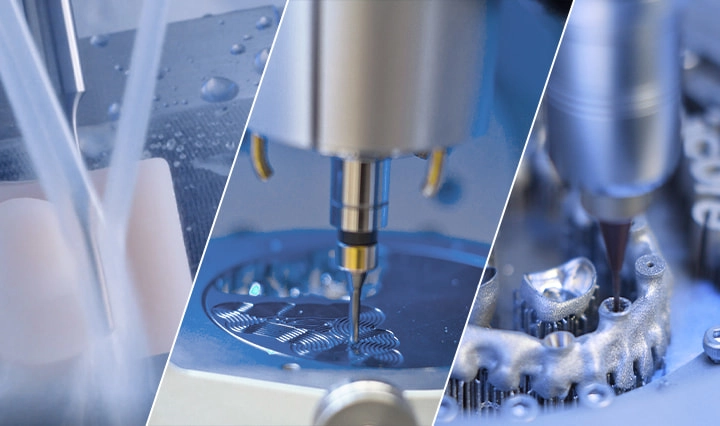
A contemporary dental workflow begins with digital data acquisition and continues through CAD design, CAM preparation, and machine-based production. In practice, this production environment is becoming increasingly diverse: zirconia frameworks may be routed to dry milling, glass ceramics to wet milling, implant components to highly controlled CAM strategies, and selected applications to additive or hybrid manufacturing environments. imes-icore’s own knowledge base emphasizes that wet and dry milling are complementary rather than competing processes, and its machine portfolio is built around integrated workflows for different indications and material classes.
What changes the game is workflow orchestration. CAM and machine software now do more than calculate toolpaths. They support object management, automatic nesting, blank management, intelligent job selection, guided cleaning and maintenance, automatic updates, and collision monitoring. This means the workflow can become rule-based: the system helps determine which case should be produced on which machine, with which tools, in which material state, and in what sequence.
A practical routing strategy starts with the indication and material. A monolithic zirconia crown for routine posterior use should not consume the same production resources as a highly aesthetic anterior glass-ceramic case or a customized implant restoration. Dry milling is typically the efficient route for materials such as pre-sintered zirconia and PMMA, while wet milling is associated with material classes such as glass ceramics and certain metal or implant-related applications depending on the setup. Routing cases correctly reduces tool stress, shortens throughput, and improves consistency.
In the laboratory, this can look like a three-lane workflow:
For high-throughput users, order management and automated nesting become especially important. imes-icore highlights exactly these functions in iCAM HD, where restoration objects can be tracked automatically and manufacturing status becomes transparent. That is highly relevant for labs that want fewer manual handovers and less uncertainty about what is ready, pending, or delayed.
Chairside environments can benefit as well. Here, routing does not necessarily mean distributing work across a large machine park; it means selecting the fastest predictable path for same-day treatment. Wizard-guided workflows, integrated nesting, and simplified operation matter because they compress training time and reduce operator-dependent errors under time pressure.
Dental practices benefit from shorter treatment times, more predictable appointments, and better control over same-day or next-day indications. When routing logic is clear, teams spend less time improvising and more time delivering patient care. Chairside users especially gain from guided, automated workflows.
Dental laboratories benefit from higher machine utilization, fewer bottlenecks, and better staff allocation. Skilled technicians can focus on complex design, esthetics, and case communication instead of constantly managing preventable workflow interruptions. Industry commentary in 2025 also pointed to automation shifting human effort away from repetitive production tasks toward higher-value work.
Milling centers benefit the most from scalable routing logic. imes-icore already frames scalability and order management as central success factors for larger production environments. Once workflows are standardized, adding capacity becomes easier because new machines and teams can be integrated into a known process model instead of creating another isolated production island.
The biggest mistake is assuming that digital automatically means optimized. Even highly automated environments can suffer from poor routing decisions, unclear material rules, inconsistent file naming, weak quality gates, or fragmented communication between CAD, CAM, and machine operation. imes-icore’s recent article on closed-loop quality assurance makes this point clearly: speed only creates value when results are predictable.
Another challenge is balancing openness with standardization. Modern labs want broad material and software compatibility, but too much variability can create process instability. The solution is not maximum freedom at every step. The solution is controlled flexibility: define validated routes for your most frequent indications, then allow exceptions only where they are economically or clinically justified. This approach aligns well with software features such as collision monitoring, user-defined quality standards, and intelligent job management.
The market direction is clear: more automation, more software-guided production, and stronger integration between design, manufacturing, and quality assurance. Workflow integration across CAD/CAM, imaging, communication, and manufacturing was highlighted in 2025 as a major driver of efficiency and patient experience, while AI-supported CAD and automated production planning are gaining visibility in the broader dental industry.
At the same time, material diversity is increasing, which makes smart routing even more important. imes-icore’s recent material and hybrid-manufacturing content points toward a future where additive and subtractive technologies coexist, and where material-specific workflows become a real competitive differentiator. In that environment, companies that can connect scanning, design, case routing, machine execution, and feedback loops will be better positioned than those relying on isolated digital tools.
The future of dental workflows is not just digital. It is selective, automated, and intelligently routed. Laboratories and practices do not need more complexity; they need better decisions about where each case should go, when it should be processed, and how quality should be monitored along the way.
For many users, this is where imes-icore solutions fit naturally into the discussion: integrated wet/dry workflows, guided machine operation, automated job handling, and CAM environments with strong process support are not just convenience features. They are the foundation for building a workflow that grows without becoming chaotic.