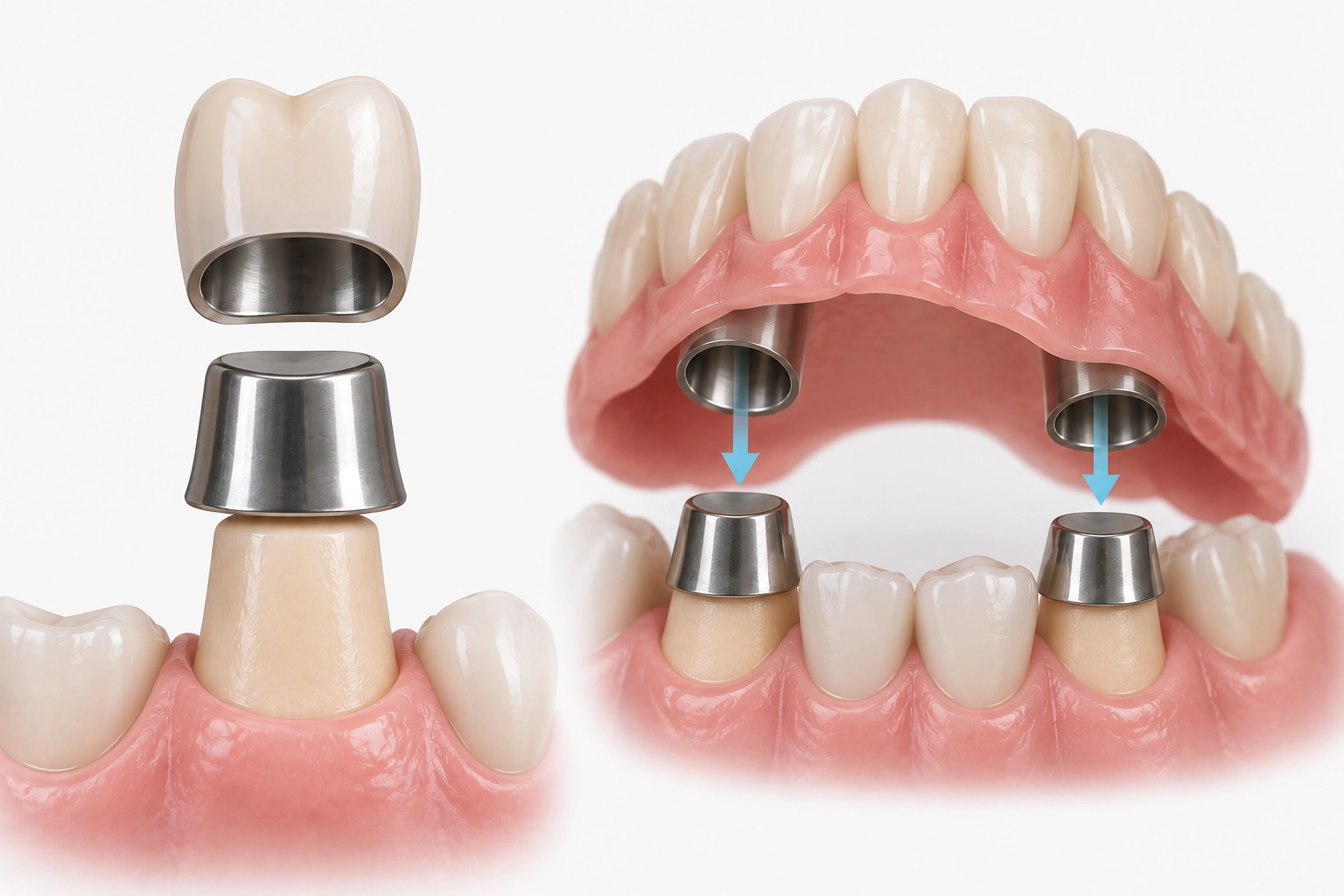
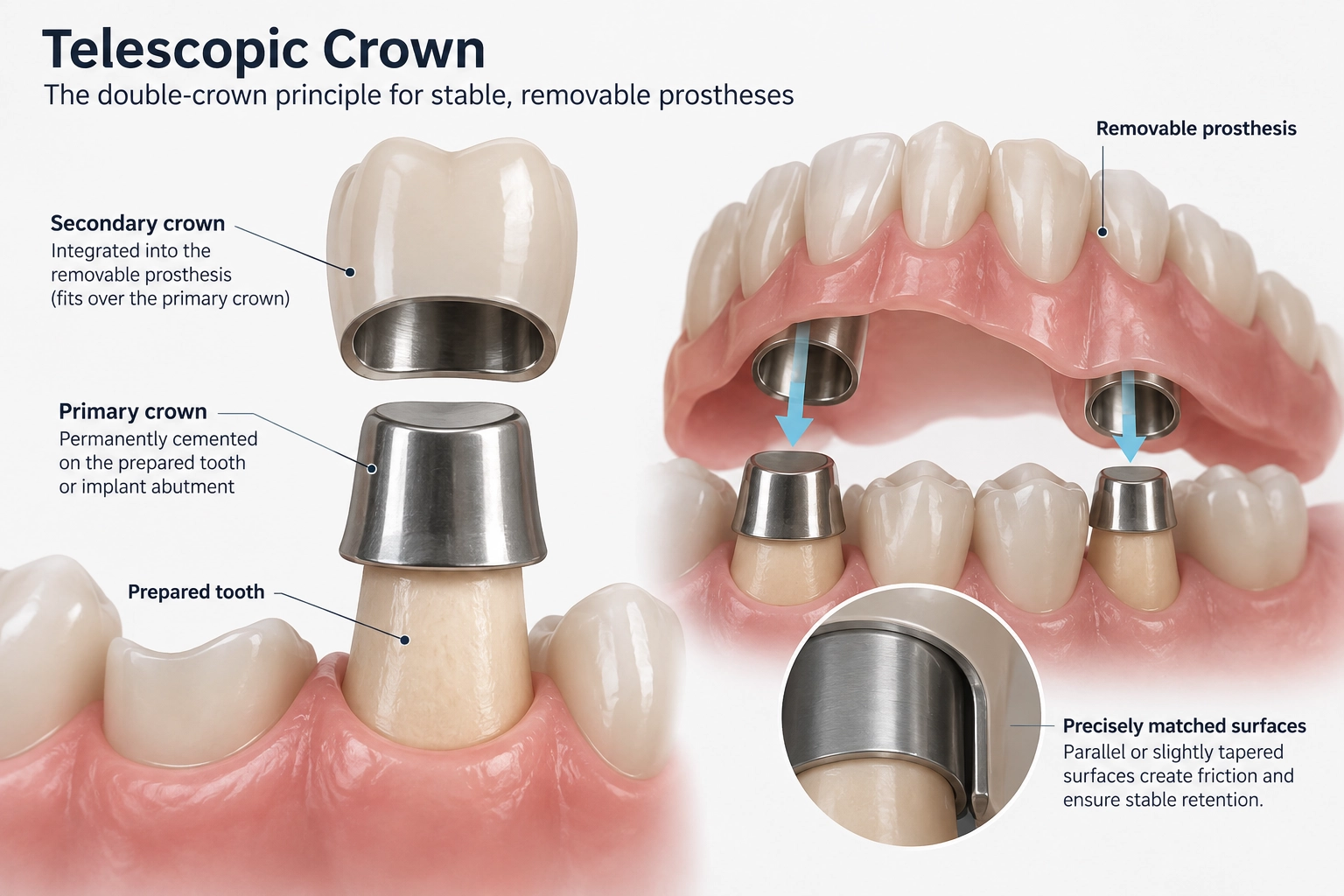
A telescopic crown system consists of two precisely matched components: a primary crown and a secondary crown.
The primary crown is permanently cemented onto a prepared natural tooth or attached to an implant abutment. It forms the fixed inner component of the restoration. The secondary crown is integrated into the removable prosthesis and fits precisely over the primary crown.
Retention is created through the carefully coordinated surfaces of these two components. Depending on the design, parallel or slightly tapered surfaces provide friction or wedging effects that stabilize the prosthesis during function while still allowing it to be removed by the patient. In digital workflows, modern milling machines can be used to manufacture these precisely matched components from materials such as CoCr or zirconia.
This double-crown principle can distribute forces across several supporting teeth and provides the removable restoration with a clearly defined insertion path. At the same time, the prosthesis remains accessible for cleaning.
Telescopic restorations are therefore frequently considered for patients with reduced or strategically distributed remaining dentition and for cases in which a removable solution requires a high degree of stability.
Both telescopic and conventional removable dentures can restore partially edentulous arches. Their retention concepts, however, are fundamentally different.
Factor | Telescopic Prosthesis | Traditional Removable Denture |
|---|---|---|
| Typical indication | Reduced but usable remaining dentition or suitable implant support | Partial or complete tooth loss |
| Stability | High due to support from primary and secondary crowns | Depends on clasps, attachments, teeth or mucosal support |
| Care | Removable for cleaning; abutments require careful hygiene | Removable for cleaning |
| Cost | Generally higher due to complex design and manufacturing | Usually lower depending on restoration type |
| Aesthetics | No visible clasps required | Clasps may be visible in some designs |
| Manufacturing | High precision required between components | Usually less demanding in terms of double-crown fit |
The main advantage of telescopic prostheses is their combination of retention and removability. Forces can be distributed across the available abutments, while the prosthesis can still be removed for hygiene and maintenance.
However, this precision also makes telescopic restorations more demanding to manufacture. The relationship between primary and secondary crowns must be carefully controlled to achieve the intended retention without making insertion or removal unnecessarily difficult.

The material combination has a major influence on the manufacturing process, fit and long-term behavior of telescopic restorations. Common options include cobalt-chromium, gold alloys and zirconia.
Cobalt-chromium
Cobalt-chromium (CoCr) offers high strength, rigidity and good wear resistance. It is widely established in removable prosthodontics and can be processed using modern CAD/CAM milling systems.
The material is comparatively cost-efficient, but its hardness makes machining demanding. Stable machine dynamics, appropriate cutting tools and carefully selected machining strategies are therefore important for achieving precise surfaces.
Gold alloys
Gold alloys have traditionally been used for telescopic crowns because of their favorable processing properties and predictable friction behavior. They can be precisely adjusted and offer excellent corrosion resistance.
Their major disadvantage is cost. High material prices and the growing availability of digitally processable alternatives mean that gold is no longer the only option for high-quality telescopic restorations.
Zirconia
Zirconia has become an important material in digital prosthodontics. It offers high strength, excellent biocompatibility and tooth-colored aesthetics. It can be efficiently processed in the pre-sintered state using CAD/CAM milling.
However, zirconia behaves differently from metallic materials. The design, material pairing and surface finishing must therefore be adapted to the intended telescopic concept rather than simply transferring conventional metal-based parameters.
Material | Advantages | Limitations | CAD/CAM Suitability |
|---|---|---|---|
| CoCr | Strong, rigid, wear-resistant, cost-efficient | Demanding machining | Very good with suitable milling equipment |
| Gold alloy | Precise fit, established friction behavior, corrosion-resistant | High material cost | Possible, but less economical |
| Zirconia | Strong, biocompatible, aesthetic, digitally efficient | Different friction and wear behavior | Excellent |

Digital production begins with accurate design. In telescopic restorations, this is particularly important because the geometry of the primary crown directly determines the fit and retention of the secondary structure.
One of the central design parameters is the taper or cone angle. Depending on the telescopic concept, angles in the range of approximately 2° to 6° may be used. Smaller angles generally create stronger retention, while larger angles can facilitate insertion and removal. The appropriate value must always be selected according to the restoration concept, material combination and number and distribution of abutments.
Equally important is establishing a common path of insertion. When several telescopic crowns are used within one restoration, their surfaces must be coordinated so that the secondary structure can be inserted and removed without interference.
Digital design tools make this process easier to control. The technician can evaluate the orientation of the individual primary crowns, define milling surfaces and adjust geometries before manufacturing begins.
Depending on the workflow, the resulting restoration data can then be prepared in iCAM for manufacturing. The digital environment makes it possible to define machining strategies according to the selected material and restoration geometry, creating a consistent transition from CAD design to production.
Once the design has been finalized, the primary and secondary components can be prepared for CAD/CAM manufacturing.
For CoCr, machining requires a rigid and precise milling system because of the material's high strength. Roughing operations remove the majority of the material before progressively finer tools create the final geometry and functional surfaces. Cutting parameters such as spindle speed, feed rate, depth of cut and tool selection must be matched to the specific CoCr material and milling system.
The final functional surfaces require particular attention. Small deviations can influence the friction between the primary and secondary crowns and therefore the retention of the entire prosthesis.
The workflow for zirconia differs significantly. Zirconia is generally milled in its softer, pre-sintered state. The CAD/CAM workflow must compensate for the material's subsequent shrinkage during sintering so that the final dimensions correspond to the digital design.
After milling, the zirconia components are sintered according to the material manufacturer's specifications and then inspected and finished. Functional surfaces should be handled carefully, as uncontrolled adjustments can alter the intended fit.
For both materials, the basic digital workflow follows the same principle:
Design → CAM preparation → Milling → Post-processing → Fit and quality control
Rather than relying on universal machining values, parameters should always follow the validated combination of machine, material, tool and CAM strategy. This is particularly important for telescopic restorations, where even small changes to functional surfaces can affect the behavior of the complete prosthesis.
Quality control is a critical final stage of telescopic manufacturing. Primary crowns should first be checked individually for marginal fit and seating on the corresponding tooth or model.
The interaction between primary and secondary crowns is then evaluated. The secondary structure should follow the planned insertion path smoothly while providing the intended retention. Excessive friction can make the prosthesis difficult to remove, whereas insufficient friction can compromise stability.
With multiple telescopic units, it is especially important to evaluate the complete restoration rather than individual crowns alone. The combined geometry of all components ultimately determines how the prosthesis behaves during insertion, removal and function.
Digital manufacturing can improve reproducibility at this stage, but precise CAD/CAM production does not eliminate the need for careful final inspection.
Telescopic crowns offer a proven method for combining the stability of fixed support with the flexibility of a removable prosthesis. Their success depends largely on the precise interaction between primary and secondary components.
CAD/CAM technology makes it possible to design these complex geometries digitally and manufacture them with a high degree of reproducibility. Materials such as CoCr and zirconia can be integrated into digital workflows, while modern CAM software and milling systems provide the precision required for demanding functional surfaces.
The key is to consider the complete process rather than individual parameters: material selection, taper angle, insertion path, machining strategy and final surface quality all influence the behavior of the finished restoration.
FAQ
What is the difference between a primary and secondary telescopic crown?
The primary crown is permanently fixed to the prepared tooth or implant abutment. The secondary crown is part of the removable prosthesis and fits precisely over the primary crown. Their interaction provides retention and stability.
What angle is used for telescopic crowns?
The appropriate taper depends on the telescopic concept, material combination and clinical situation. Cone angles of approximately 2° to 6° are commonly considered in relevant designs, but there is no universal angle suitable for every restoration.
Can telescopic crowns be milled with CAD/CAM?
Yes. CAD/CAM technology can be used to design and manufacture primary and secondary components from suitable materials. Precise machine dynamics, appropriate tools and validated CAM strategies are particularly important because the functional surfaces determine the fit and retention.
Is zirconia suitable for telescopic crowns?
Zirconia can be used in selected telescopic concepts and is well suited to digital manufacturing. Its mechanical and frictional behavior differs from metal, so the design, material pairing and finishing process must be adapted accordingly.
Why is milling accuracy particularly important for telescopic prostheses?
The retention of a telescopic restoration depends on the interaction between precisely defined primary and secondary surfaces. Manufacturing deviations or uncontrolled finishing can change the friction and therefore affect insertion, removal and stability.