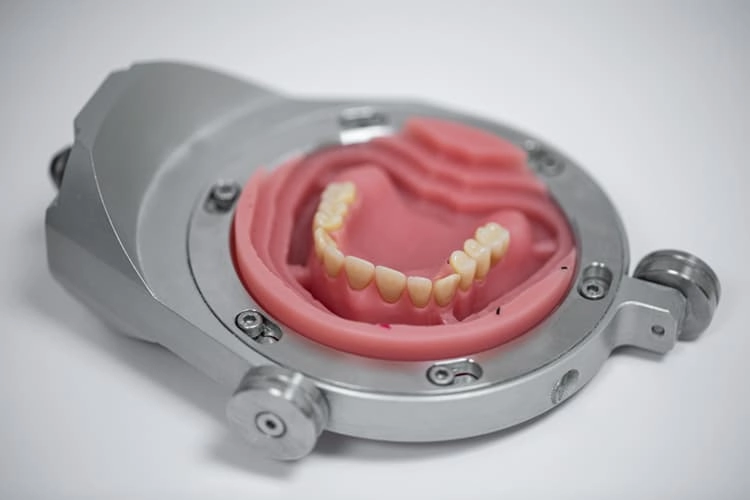
A total prosthesis, or complete denture, is a removable dental restoration that replaces all missing teeth in the upper or lower jaw. It restores essential functions such as chewing and speaking while supporting facial aesthetics and the patient’s overall appearance.
A complete denture primarily consists of a denture base and artificial teeth. Traditionally, these components are created through several manual laboratory steps, including taking impressions, producing models, recording the bite relationship and positioning the teeth in wax before the final denture is processed. Today, digital workflows using CAD/CAM software and milling machines offer an efficient alternative to these conventional methods.
Digital denture fabrication follows the same fundamental prosthetic principles but transfers many of these steps into a digital environment. Patient information is captured or digitized, the denture is designed using CAD software and the final components can then be manufactured using CAD/CAM technology.
The goal is not to change the basic function of the restoration, but to make its production more standardized, reproducible and efficient.

Both conventional and digital workflows can produce high-quality complete dentures. The main differences are found in the production process, the degree of automation and the way patient and restoration data are handled.
Factor | Traditional Method | Digital CAD/CAM Method |
|---|---|---|
| Accuracy | Highly dependent on impressions and manual processing | High and reproducible with accurate digital data |
| Customization | Very high through manual characterization | High through digital design and additional finishing |
| Production time | Multiple manual laboratory stages | Fewer manual production steps |
| Cost structure | Lower initial equipment investment, higher manual workload | Higher initial investment, potential savings through automation |
| Reproducibility | Remake often requires several steps to be repeated | Digital design can be stored and reproduced |
| Workflow | Primarily manual | Digitally connected and standardized |
One of the biggest advantages of the traditional method is the dental technician's direct control over each individual step. Experienced technicians can make highly detailed adjustments to tooth position, gingival design and aesthetics.
Digital production, on the other hand, reduces the number of manual manufacturing stages. Once a case has been digitized, the data can move directly through design and manufacturing. This makes the process easier to standardize and can reduce variations between restorations.
Another important advantage is reproducibility. If a digitally produced denture is lost or damaged, the stored design data can potentially be used to manufacture it again without completely restarting the design process.

A digital complete denture workflow combines data acquisition, virtual design and CAD/CAM manufacturing. Depending on the clinical situation, some conventional steps may still be required, especially when obtaining functional impressions or recording the jaw relationship.
Step 1: Capture or digitize patient data
The workflow begins by capturing the anatomical situation. Depending on the case, data may originate from an intraoral scan, a laboratory scan of an impression or model, or the digitization of an existing denture.
For edentulous patients in particular, accurately recording movable soft tissue and functional borders can be more challenging than scanning dentate patients. This means that digital and conventional methods may also be combined in a hybrid workflow.
Once the necessary information has been collected, it provides the digital basis for designing the new prosthesis.
Step 2: Digital denture design
The patient data is imported into the CAD environment, where the complete denture is designed virtually.
Using appropriate dental CAD software, the technician can define the denture base, tooth setup, occlusion and other prosthetic parameters. Digital tools make it possible to evaluate the design from different perspectives and make adjustments before manufacturing begins.
Because the design exists as a digital dataset, modifications can be documented and reproduced more easily than in a purely manual workflow.
Step 3: CAM preparation and milling
After the design has been approved, the restoration is prepared for manufacturing. CAM software calculates the required milling strategy, toolpaths and machining parameters.
For many digital denture workflows, the denture base or other components can be milled from industrially manufactured PMMA discs using a suitable CORiTEC milling system.
Milling from a prefabricated blank provides controlled material properties and avoids several processing steps associated with conventional polymerization techniques.
Step 4: Finishing the prosthesis
After milling, the individual components are finished and assembled according to the selected workflow. This may include polishing, bonding the denture teeth to the base and adding individual characterization.
The final denture is then checked for fit, occlusion, function and aesthetics before delivery to the patient.
Material selection depends on which component of the prosthesis is being produced and whether the restoration is intended as a temporary or definitive solution.
PMMA
PMMA is one of the most important materials for digitally manufactured dentures. It can be efficiently milled and is available in different shades and configurations for denture bases and teeth.
Advantages include good machinability, predictable material properties and efficient polishing. Prefabricated PMMA blanks also provide standardized material quality.
Wax
Wax is primarily used as an intermediate material rather than for the definitive prosthesis. It can be milled quickly and is useful for try-ins or workflows in which the digital design is subsequently transferred to a conventional manufacturing process.
Its main advantage is easy processing, while its limited mechanical properties make it unsuitable as a definitive denture material.
Zirconia
Zirconia offers significantly greater strength and wear resistance than PMMA and can be used for selected components or prosthetic concepts. Its high mechanical stability can be beneficial where durability is particularly important.
However, zirconia requires more demanding milling and subsequent sintering. It is also considerably more rigid than PMMA, making it unsuitable as a direct replacement for conventional denture-base materials in many applications.
Material | Main Advantages | Limitations |
|---|---|---|
| PMMA | Easy to mill, predictable, aesthetic, cost-efficient | Lower wear resistance than zirconia |
| Wax | Fast processing, ideal for try-ins | Not suitable for definitive restorations |
| Zirconia | Very high strength and wear resistance | More complex processing, high rigidity |

Digital complete denture fabrication is particularly attractive when laboratories want to standardize production and reduce repetitive manual steps. It can also be valuable when a high degree of reproducibility is required.
The ability to store the patient's restoration data is especially useful for repeat cases. If a denture needs to be replaced, the existing digital design provides a valuable starting point for manufacturing a new restoration.
Digital manufacturing can also benefit laboratories with an established CAD/CAM infrastructure. Existing scanners, software and milling machines can be integrated into the workflow, allowing laboratories to expand their digital production portfolio.
However, digital does not automatically mean better for every case. Capturing the anatomy of a completely edentulous jaw can remain challenging, particularly when functional soft-tissue information is required. Complex aesthetic cases may also benefit from extensive manual characterization by an experienced dental technician.
For this reason, hybrid workflows can provide a practical solution: conventional clinical techniques are used where they offer advantages, while design and manufacturing are transferred to the digital environment.
Digital CAD/CAM technology is changing the way complete dentures can be designed, manufactured and reproduced. Compared with traditional methods, digital fabrication reduces many manual production steps and provides a standardized workflow from patient data to the final prosthesis.
PMMA milling in particular offers an efficient approach for producing denture components with consistent material properties. Combined with digital design and a suitable CORiTEC milling system, laboratories can integrate complete denture fabrication into their existing CAD/CAM production.
Traditional techniques nevertheless remain valuable, especially when functional impressions, complex clinical situations or extensive individualization are required. Rather than replacing conventional denture fabrication entirely, digital technology expands the available options and enables laboratories to select the most efficient workflow for each case.
FAQ
How long does a digital complete denture last?
The lifespan of a digital complete denture depends on the material, fit, patient-specific conditions, oral hygiene and wear. Digitally manufactured dentures are subject to the same clinical influences as conventionally produced restorations. Regular dental check-ups remain important to assess fit, function and material condition over time.
Can a complete denture be made chairside?
Parts of the workflow can be performed digitally within the dental practice, but complete dentures generally involve more clinical and manufacturing steps than a typical chairside crown. Whether an in-house workflow is practical depends on the available scanning, CAD/CAM and finishing equipment as well as the complexity of the case.
What is the main advantage of digital dentures?
One of the most important advantages is reproducibility. The digital design can be stored, modified and reused, simplifying future adjustments or replacement of the prosthesis.
Are digital dentures more accurate than traditional dentures?
Digital manufacturing can provide highly reproducible results and reduce variations caused by manual production steps. However, the final accuracy also depends on the quality of the clinical records, data acquisition, design and manufacturing process.