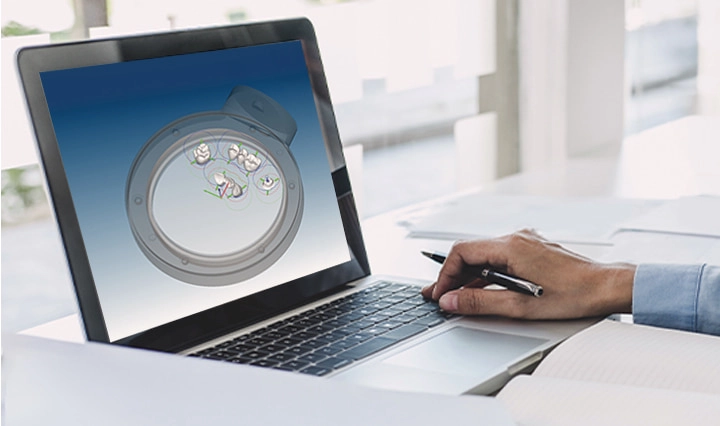
A modern digital dental workflow is built on a chain of interdependent steps: data capture, CAD design, CAM preparation, manufacturing, finishing, and quality control. The more digitalized this chain becomes, the more important it is to know exactly what happened, when, on which system, and with which parameters. Reviews of digital workflows in prosthodontics describe this broader shift toward integrated, outcome-driven, and increasingly standardized treatment and production processes.
Traceability is enabled by several technological building blocks:
Digital case files
Each case begins with structured data: intraoral scans, model scans, prescriptions, indication details, shade information, and material selection. Centralized case management ensures that all stakeholders work from the same information base.
Version-controlled CAD data
Design adjustments are common in everyday lab work. When CAD versions are documented clearly, teams can understand why a design was changed, who approved it, and which version was finally produced.
CAM and machine documentation
This is where true process transparency begins. Important parameters include nesting position, tool selection, milling strategy, spindle hours, tool wear, and material indication. Modern dental milling environments increasingly support exactly this kind of data-backed production logic. imes-icore’s own machine ecosystem is positioned around integrated CAD/CAM environments, automated calibration, tool monitoring, and digital archiving—features that directly support traceable workflows.
Batch and material traceability
For zirconia, PMMA, titanium, CoCr, or hybrid materials, documenting the batch and indication is essential for internal quality assurance and, where relevant, complaint handling.
Digital quality assurance
The latest imes-icore Workflow articles show that the market is already moving from “digital production” toward “closed-loop quality assurance,” where process monitoring and documented checkpoints become part of the standard CAD/CAM workflow.
Traceable workflows are especially valuable in environments where multiple cases, materials, and operators have to be managed simultaneously.
Dental laboratories
Labs benefit when every case can be tracked from incoming scan to delivery. If a remake occurs, the root cause can be identified faster: Was the issue scan quality, design parameters, material choice, tool wear, or finishing? Instead of relying on assumptions, the team can work with evidence.
Milling centers
For higher-throughput production, traceability becomes even more important. Milling centers often process a wide range of indications and materials across multiple machines. Here, documented workflows help standardize output, reduce scrap, and improve training for operators. This aligns well with the broader trend toward automated, software-supported production ecosystems in dental manufacturing.
Dental practices with chairside or integrated digital workflows
Even in practice-based workflows, documentation matters. Scan quality, preparation data, restoration design, and material selection all influence the final result. As chairside workflows continue to expand, structured documentation can help practices improve case selection, reduce repeat appointments, and build confidence in same-day or short-turnaround restorations.
Complaint management and remakes
One of the most practical use cases is post-case analysis. A documented workflow makes it easier to answer critical questions:
That transforms troubleshooting from guesswork into process control.
For dental laboratories
Traceability improves internal quality management, team coordination, and reproducibility. It also shortens onboarding times for new employees because processes are less dependent on undocumented individual experience.
For milling centers
The biggest advantages are scalability and consistency. When workflows are documented properly, higher output does not automatically mean higher process risk. Standardized machine environments, validated strategies, and clear data records support profitable production growth.
For dentists and practices
Better documentation means more transparency when communicating with laboratories or milling centers. That improves collaboration and supports more predictable outcomes.
For patients
Patients may never see the production log, but they benefit from its effects: fewer remakes, more consistent fit, shorter turnaround times, and better confidence in the final restoration.
Despite its advantages, traceability is not implemented automatically just because a business uses digital tools.
Data fragmentation
Many workflows still suffer from disconnected software environments. Case data, CAD files, machine logs, and quality documentation are often stored in different systems.
Additional process discipline
A traceable workflow requires standard naming conventions, defined handover rules, and consistent documentation habits. Without team discipline, even powerful software cannot create reliable traceability.
Training requirements
Digital dentistry can improve efficiency, but studies also note the burden of training, usability challenges, and digital stress when systems are not integrated well into daily work. That makes workflow design just as important as hardware investment.
Investment and integration
Not every lab or practice needs a fully automated data environment immediately. The more realistic goal is often stepwise implementation: first standardize files and case data, then improve CAM documentation, then connect quality checks and archiving.
The next phase of digital dentistry is not simply “more digital.” It is more controlled digitalization. Recent reviews show that digital workflows continue to expand across prosthodontics and implantology, while process integration, automation, and quality control are becoming increasingly important.
In the market, this means three clear developments:
1. Process transparency will become a sales argument
Customers increasingly want reliable turnaround times and predictable quality—not just modern equipment.
2. Documentation will support automation
As machine parks become smarter, traceable data will help optimize tool use, maintenance cycles, nesting logic, and quality checkpoints.
3. Integrated ecosystems will gain relevance
Labs and milling centers will increasingly favor machine and software environments that reduce media breaks, centralize production data, and support validated workflows. This is exactly where manufacturers with strong CAD/CAM integration and automation expertise, such as imes-icore, can create real value for users.
Traceability is becoming one of the most underestimated success factors in digital dental workflows. It turns digital production into manageable production. For laboratories, milling centers, and digitally active practices, documented workflows improve quality, simplify remakes analysis, strengthen team coordination, and create a better foundation for growth.
Recommendations:
In digital dentistry, speed may win attention. But traceability wins trust.
What does traceability mean in digital dental workflows?
Traceability means that every relevant step in a digital dental workflow can be documented and reviewed. This includes scan data, CAD design versions, CAM settings, material batches, machine parameters, and quality control results.
Why is traceability important for dental laboratories?
Traceability helps laboratories improve reproducibility, reduce remakes, and identify the causes of errors more quickly. It also supports better team coordination and creates a stronger basis for quality assurance.
How does traceability help reduce remakes?
When every process step is documented, labs and milling centers can analyze exactly where deviations occurred. This makes it easier to identify whether the issue came from scan quality, design decisions, material selection, tool wear, or post-processing.
Which workflow steps should be documented?
Important steps include scan acquisition, case information, CAD design versions, CAM strategies, machine settings, material batches, tool usage, finishing processes, and final quality checks.
Is traceability only relevant for large milling centers?
No. Traceability is useful for dental laboratories, milling centers, and digitally oriented dental practices of all sizes. Even smaller businesses benefit from better process transparency and more consistent results.
How can a lab start implementing traceable workflows?
A practical first step is to standardize case naming, file storage, and handover rules. After that, businesses can gradually add CAD version control, material documentation, CAM records, and digital quality checks.
What role does software integration play in traceability?
Integrated software environments reduce data fragmentation and make it easier to connect case files, design data, machine information, and quality documentation. This improves workflow transparency and efficiency.
Can traceability improve communication between practice and laboratory?
Yes. Clear documentation creates a shared information base for dentists, labs, and milling centers. This reduces misunderstandings and supports smoother collaboration throughout the case.
Does traceability slow down production?
At the beginning, it may require more discipline and structure. In the long term, however, it usually saves time because fewer errors occur, troubleshooting becomes faster, and workflows become more standardized.
Why is traceability becoming a competitive advantage?
Customers increasingly expect predictable quality, reliable delivery, and transparent processes. Traceable workflows help labs and milling centers meet these expectations and position themselves as dependable digital partners.