Lithium disilicate is a glass-ceramic dental material designed to combine mechanical strength with natural-looking aesthetics. Its microstructure consists of lithium disilicate crystals embedded within a glassy matrix.
This structure gives the material a combination of translucency, strength and fracture resistance that makes it particularly attractive for highly aesthetic restorations. Different levels of translucency and opacity also allow technicians and clinicians to select the appropriate material according to the underlying tooth structure and desired aesthetic result.
Unlike zirconia, lithium disilicate contains a significant glass phase. This contributes to its optical properties and also allows the restoration to be conditioned for adhesive bonding according to the material manufacturer's instructions.
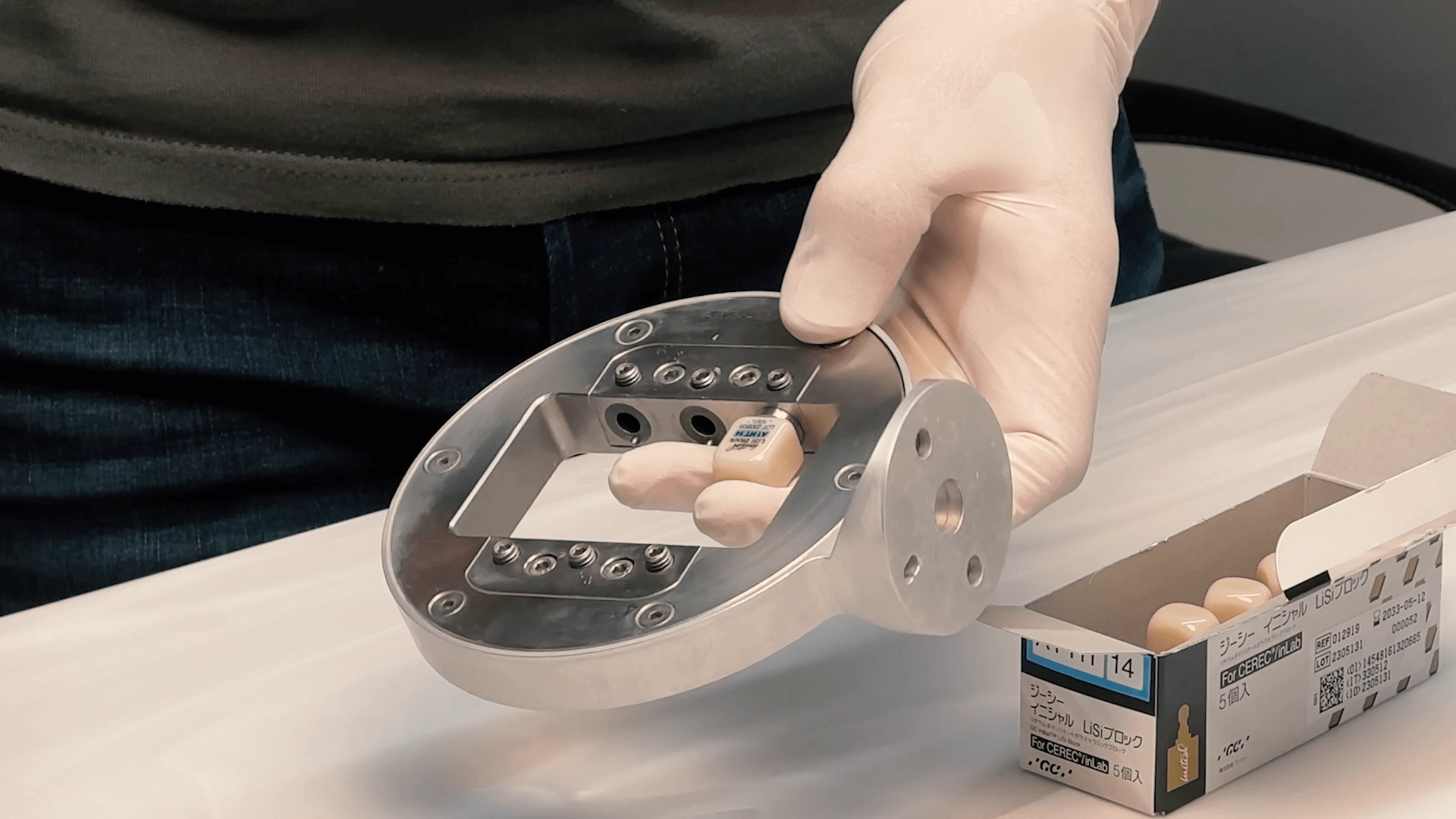
In a digital workflow, lithium disilicate can be processed from standardized CAD/CAM blocks. One of the best-known examples is IPS e.max CAD, which is machined in an intermediate crystalline state and subsequently crystallized to develop its final properties.

Lithium disilicate restorations can be produced using different manufacturing techniques. Two established approaches are CAD/CAM milling and the traditional press technique.
IPS e.max CAD is specifically designed for digital manufacturing. The restoration is designed virtually and then milled from a prefabricated block. The material is supplied in a partially crystallized intermediate state, recognizable by its characteristic blue color. In this condition, it is easier to machine and causes less tool wear than the fully crystallized ceramic. The restoration receives its final strength and optical characteristics during subsequent crystallization.
IPS e.max Press, in contrast, is manufactured using the lost-wax and heat-pressing technique. A wax pattern of the restoration is invested, burned out and replaced with lithium disilicate ceramic during the pressing process.
Factor | IPS e.max CAD | IPS e.max Press |
| Manufacturing | CAD/CAM milling | Heat-press technique |
| Starting form | Prefabricated block | Ceramic ingot |
| Workflow | Fully digital design and machining | Wax-up and pressing |
| Automation | High | More manual laboratory steps |
| Typical strength | High | High |
| Main advantage | Fast, reproducible digital production | High degree of laboratory individualization |
Both approaches use lithium disilicate glass-ceramic and can produce high-quality restorations. CAD blocks are particularly attractive for digital and chairside workflows, while press variants remain established for laboratory workflows and highly individualized restorations.
Lithium disilicate requires a different machining strategy from softer materials such as PMMA or pre-sintered zirconia.
CAD/CAM lithium disilicate is generally processed using wet machining. Water or another approved cooling medium helps control the temperature at the cutting interface and removes ceramic particles during processing.
The exact spindle speed, feed rate and toolpath should not be defined by a universal value. These parameters depend on the block, milling machine, tool geometry and validated CAM strategy. Using predefined material-specific strategies helps coordinate these factors and reduces the risk of chipping or unnecessary tool wear.
Tool condition is particularly important. Worn tools can negatively affect margins and surface quality, especially in thin or detailed areas of the restoration. The appropriate diamond-coated or material-specific grinding tools should therefore be used according to the machine and material manufacturer's recommendations.
Block selection also influences the final result. IPS e.max CAD, for example, is available in different translucency levels such as HT, MT, LT and MO, allowing the material to be selected according to the indication and aesthetic requirements.
After machining, the restoration is separated from the block and carefully finished before crystallization.
Crystallization is a crucial step in the CAD/CAM lithium disilicate workflow. It transforms the machined restoration from its intermediate state into the final ceramic structure and develops its definitive mechanical and optical properties.
For IPS e.max CAD, crystallization takes place in a suitable ceramic furnace. Traditional manufacturer programs reach final firing temperatures around 840–850 °C, depending on the furnace and specific program. Current Ivoclar systems also offer dedicated speed programs rather than requiring users to manually define individual temperature parameters.
The exact program should therefore always follow the current instructions for the selected material and furnace. Parameters such as heating rate, holding time, vacuum and cooling are coordinated with the material and should not be transferred from one furnace system to another without validation.
Modern workflows can make this step relatively fast. For example, Ivoclar specifies a crystallization time of 11 minutes and 10 seconds for selected IPS e.max CAD restorations using the Programat CS6 Superspeed program under the specified conditions.
During crystallization, the restoration develops its final shade and translucency as well as its final material properties. Depending on the selected workflow, staining and glazing can be integrated into or performed around the crystallization process.
The combination of strength and aesthetics makes lithium disilicate suitable for a broad range of restorative applications.
Crowns are one of the most common indications. The material's optical properties allow restorations to integrate naturally into both anterior and posterior regions, while its mechanical properties provide the strength required for many single-unit restorations.
For onlays and partial crowns, lithium disilicate is particularly interesting because modern adhesive techniques can support more conservative preparation concepts. Instead of removing additional tooth structure for a full crown, the restoration can be designed to replace only the damaged areas where clinically appropriate.
Veneers benefit from the material's translucency and shade options. Thin restorations can reproduce the optical appearance of natural enamel while allowing a high degree of aesthetic individualization.
IPS e.max CAD is indicated by its manufacturer for veneers, inlays, onlays and crowns, among other applications. The appropriate restoration design, minimum material thickness and cementation protocol should always follow the material-specific instructions.

Lithium disilicate and zirconia are both widely used in digital dentistry, but their different material structures result in different strengths and applications.
Property | Lithium Disilicate | Zirconia |
| Material type | Glass-ceramic | Polycrystalline ceramic |
| Strength | High | High to very high, depending on zirconia type |
| Translucency | Very high | Moderate to high, depending on generation |
| Aesthetics | Excellent | Very good to excellent |
| CAD/CAM processing | Usually wet machining from blocks | Usually dry milling in pre-sintered state |
| Post-processing | Crystallization | Sintering |
| Adhesive bonding | Well established due to glass phase | Requires different surface treatment |
| Typical applications | Veneers, inlays, onlays, crowns | Crowns, bridges, frameworks, implant restorations |
Lithium disilicate is particularly attractive when aesthetics and adhesive bonding are priorities. Zirconia, on the other hand, offers greater mechanical strength in many material variants and is therefore widely used for restorations with higher load requirements or larger-span indications.
The choice should consequently be based on the clinical indication, available space, aesthetic requirements and restorative design rather than considering one ceramic universally superior to the other.
Lithium disilicate combines aesthetics, strength and efficient digital processing, making it one of the most versatile materials in modern CAD/CAM dentistry.
The workflow is straightforward: the restoration is digitally designed, machined from a prefabricated block and subsequently crystallized to achieve its final mechanical and optical properties. With suitable milling strategies, dedicated tools and controlled crystallization programs, crowns, onlays, veneers and other restorations can be produced efficiently and reproducibly.
For dental practices and laboratories, lithium disilicate therefore provides an important link between digital manufacturing and highly aesthetic restorative dentistry.
FAQ
What is lithium disilicate used for in dentistry?
Lithium disilicate is commonly used for aesthetic all-ceramic restorations including crowns, veneers, inlays and onlays. The exact indications depend on the selected material system.
Does lithium disilicate need to be crystallized after milling?
CAD/CAM materials such as IPS e.max CAD are machined in an intermediate crystalline state and require subsequent crystallization. This process develops the restoration's final strength, shade and translucency.
At what temperature is lithium disilicate crystallized?
The temperature depends on the material and furnace program. For IPS e.max CAD, established crystallization programs reach approximately 840–850 °C. The current manufacturer-specific firing program should always be followed rather than applying a universal temperature.
Is lithium disilicate stronger than zirconia?
Generally, zirconia offers higher flexural strength than lithium disilicate, although values vary considerably between zirconia types. Lithium disilicate instead combines high strength with excellent translucency and established adhesive bonding properties, making both materials suitable for different clinical requirements.
Can lithium disilicate be used for same-day restorations?
Yes. CAD/CAM lithium disilicate is well suited to chairside workflows. With compatible milling and firing equipment, suitable restorations can be designed, machined, crystallized and inserted within a single appointment.