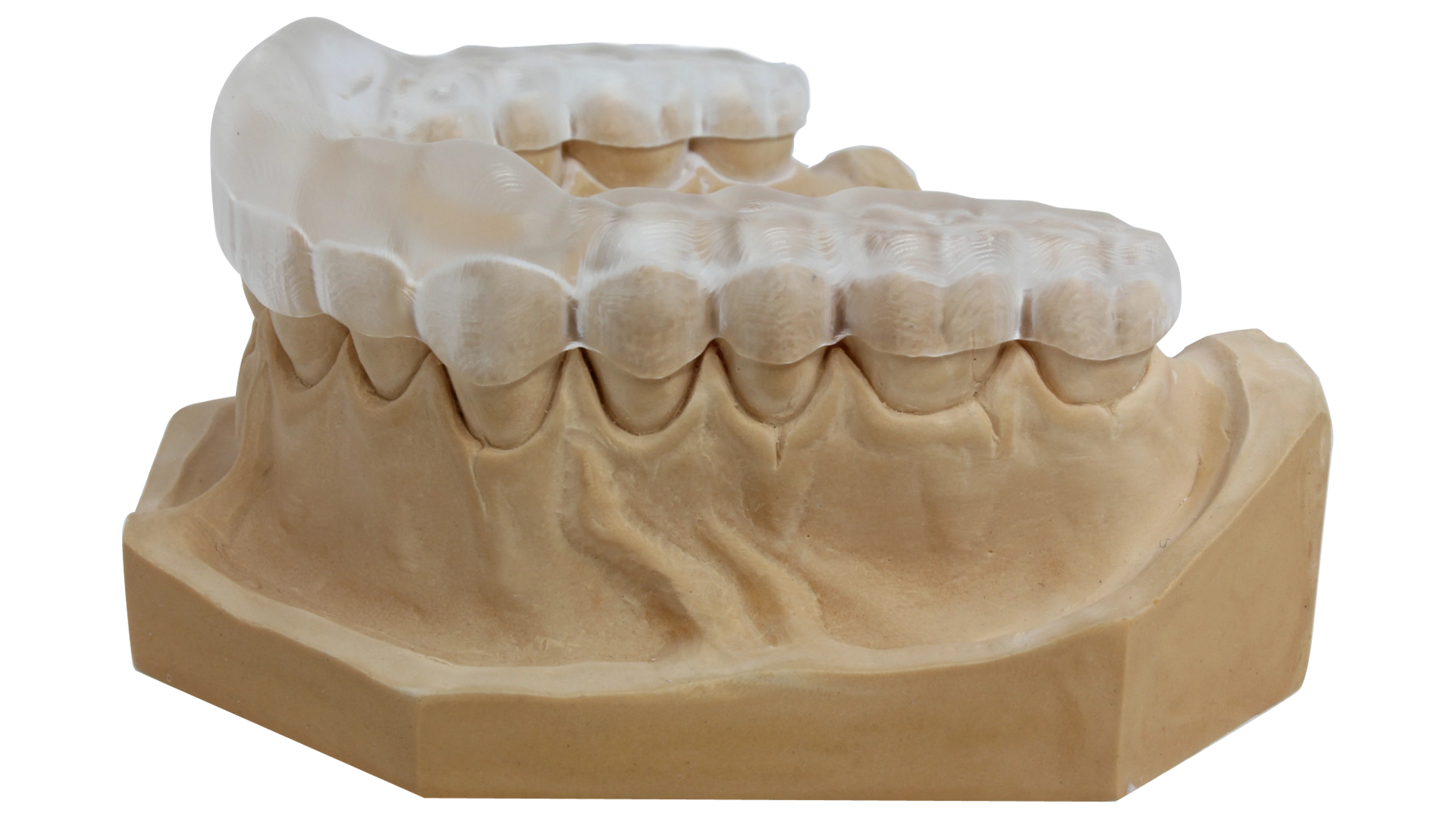
An occlusal splint is a removable dental appliance that covers part or all of the dental arch and creates a defined contact surface between the upper and lower teeth.
Depending on its design, a splint can protect natural teeth and restorations from excessive wear, redistribute occlusal forces or modify contacts between the upper and lower jaw. Stabilization splints are also used as part of the management of selected temporomandibular disorders (TMD).
The appropriate design depends on the individual clinical situation. A patient with severe bruxism, for example, may require a different appliance from someone receiving a splint for short-term functional therapy.
Regardless of the design, fit, material stability and accurately defined occlusal contacts are essential. This makes splints particularly suitable for digital production, where these parameters can be precisely controlled during CAD design before the appliance is manufactured using Dental Milling Machines and suitable CAD/CAM materials.

Several splint concepts are used in dentistry. They differ primarily in coverage, rigidity and intended therapeutic function.
Splint type | Typical indication | Typical material | Typical thickness* |
| Michigan splint | Bruxism, stabilization, selected TMD cases | Rigid PMMA / CAD/CAM polymer | Approx. 2–4 mm |
| NTI-type appliance | Selected cases requiring anterior contact and posterior disclusion | Rigid polymer | Design-dependent |
| Tanner-type splint | Occlusal stabilization and functional therapy | Rigid PMMA / polymer | Approx. 2–4 mm |
| Soft splint | Tooth protection, selected bruxism cases | Flexible thermoplastic | Approx. 2–4 mm |
*Thickness values are general orientation ranges only. Final dimensions must be determined according to the clinical indication, appliance design, material and manufacturer specifications.
The Michigan splint is one of the best-known designs. It is a rigid, full-coverage stabilization appliance that provides controlled contacts across the dental arch. It is commonly associated with the management of bruxism and selected muscular or temporomandibular complaints.
An NTI-type appliance, in contrast, provides contact primarily in the anterior region rather than covering the complete occlusal surface in the same way as a stabilization splint. Because this changes the distribution of occlusal contacts substantially, its use requires careful case selection and clinical monitoring.
Tanner-type splints are also rigid stabilization appliances designed around defined occlusal relationships and functional guidance.
Soft splints use flexible materials and can provide a comfortable solution for selected indications. However, their mechanical behavior differs significantly from rigid CAD/CAM appliances, so material selection should always follow the intended therapeutic concept.

Traditionally, occlusal splints are fabricated from an impression and dental model. The appliance is manually designed, processed from acrylic resin and subsequently adjusted to establish the desired occlusal contacts.
This method is well established but involves several manual stages. Polymerization and processing can also introduce variables that influence dimensional stability and fit.
A CAD/CAM workflow transfers much of this process into a digital environment. After the patient's dental arches and bite have been scanned, the splint is designed virtually. Parameters such as thickness, extension, occlusal contacts and functional surfaces can be defined before manufacturing.
The finished design is then milled from a prefabricated material blank. Because these blanks are industrially polymerized under controlled conditions, milling avoids the polymerization shrinkage associated with some conventional processing methods.
Studies comparing fabrication techniques have found advantages for milled splints in areas such as dimensional accuracy, fracture resistance and wear behavior, although performance varies considerably between specific materials.
Another important advantage is reproducibility. Once the design has been stored digitally, the splint can be modified or manufactured again without recreating the complete design from the beginning.
Material selection has a direct influence on rigidity, wear resistance, comfort and machinability.
PMMA
PMMA (polymethyl methacrylate) is one of the most established materials for occlusal splints. CAD/CAM PMMA blanks are industrially polymerized and provide predictable mechanical properties as well as good machinability and dimensional stability.
Recent laboratory research has shown particularly strong flexural and wear performance for milled PMMA compared with the tested conventional and 3D-printed alternatives.
PEEK
PEEK (polyetheretherketone) is a high-performance thermoplastic with high toughness and good biocompatibility. Its mechanical behavior differs considerably from conventional acrylic materials, making it an interesting option for selected occlusal appliances.
Research on occlusal-device materials has reported favorable wear behavior for PEEK, although clinical material selection should consider the complete appliance design rather than wear resistance alone.
Composites
CAD/CAM composites provide another option for digitally manufactured splints. Their properties vary depending on the polymer matrix and filler composition. Some materials combine good machinability with high mechanical stability and can therefore be suitable for long-term appliances.
A 2026 systematic review found that milled materials generally showed high physical and mechanical stability under artificial aging, with milled composite resins performing particularly well in the studies evaluated.
Material | Main advantages | Considerations |
| PMMA | Proven, precise, easy to mill, good wear resistance | Rigid; properties vary by product |
| PEEK | Tough, lightweight, good wear characteristics | Different processing and finishing requirements |
| Composite | High mechanical stability, material-specific flexibility | Properties depend strongly on formulation |
There is therefore no single material that is automatically best for every splint. The indication, design, required rigidity and validated manufacturing workflow should determine the selection.
Digital fabrication begins with an accurate representation of the patient's upper and lower dental arches. An intraoral scanner can capture both arches as well as the bite relationship, eliminating the need for a conventional impression in suitable cases.
The scan data is then transferred to the CAD environment. Here, the splint is designed according to the therapeutic requirements. The technician can define the insertion path, material thickness, extension and occlusal surfaces while checking the relationship with the opposing dentition.
Once the design is complete, the data is transferred to the CAM software. The splint is positioned within the selected material blank and the appropriate machining strategy is calculated.
The milling machine then produces the appliance from PMMA, PEEK or another approved CAD/CAM material. Depending on the material and system, different tools and machining strategies are required. Rather than using universal milling parameters, the validated combination of material, tools, machine and CAM strategy should always be followed.
After milling, the splint is separated from the blank and the connecting points are carefully finished. The surface is polished according to the material manufacturer's instructions before the final fit and occlusion are checked.
The complete workflow can therefore be summarized as:
Scan → CAD design → CAM preparation → Milling → Finishing → Fit and occlusal control
Because the design remains available digitally, adjustments can be documented and the appliance can potentially be reproduced more efficiently if replacement becomes necessary.

Digital CAD/CAM technology provides an efficient and reproducible approach to occlusal splint fabrication. Instead of relying entirely on manual processing, laboratories can digitally control appliance geometry, thickness and occlusal contacts before milling the final splint from an industrially manufactured blank.
PMMA remains an important material for milled splints, while PEEK and modern composite materials provide additional options for specific requirements. The appropriate combination ultimately depends on the clinical indication, appliance design and validated manufacturing workflow.
With accurate digital data, suitable CAD software and precise milling technology, occlusal splints can become another application within an integrated digital dental workflow.
FAQ:
What is the best material for an occlusal splint?
There is no single best material for every patient or indication. Milled PMMA is widely established and offers a combination of accuracy, rigidity and wear resistance. PEEK and CAD/CAM composites can provide advantages for specific requirements. The material should always be selected according to the clinical indication and appliance design.
How long does a milled occlusal splint last?
There is no universal lifespan for a milled splint. Durability depends on the material, appliance thickness, intensity of bruxism, occlusal forces, maintenance and individual patient factors. Current research indicates favorable mechanical and wear properties for milled materials, but regular clinical checks remain important.
Are CAD/CAM splints more accurate than conventional splints?
Digital milling can provide highly reproducible manufacturing and good dimensional accuracy. However, the final fit depends on the complete workflow, including scanning, CAD design, milling and finishing. Recent clinical research has also demonstrated high fit accuracy for milled occlusal devices.
Can an occlusal splint be reproduced digitally?
Yes. One of the advantages of a CAD/CAM workflow is that the digital design can be stored. If a splint is lost or damaged, the existing dataset can provide the basis for producing a replacement, although the patient's current clinical situation should be checked first.