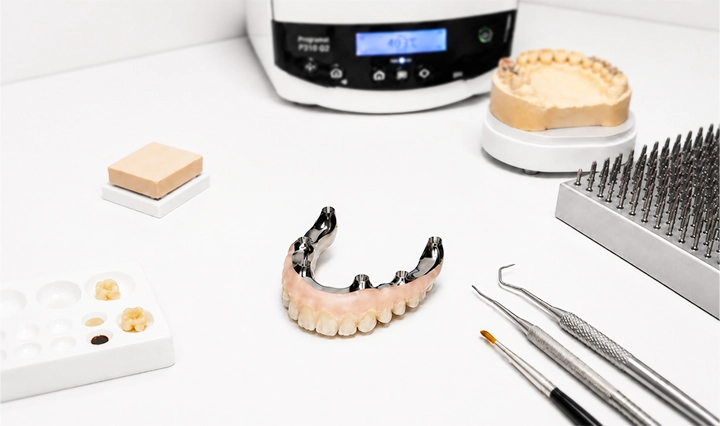
Passive fit describes a stress-reduced connection between the implant-supported prosthesis and the underlying implants or abutments. Unlike natural teeth, implants have only minimal physiological mobility, so discrepancies that might be tolerated elsewhere can create biologic or mechanical complications in implant prosthetics. In full-arch cases, these risks are amplified because inaccuracies can accumulate over long spans, multiple implant positions, and several digital and manual transfer steps.
Digital workflows have significantly improved the situation. Intraoral scanning, photogrammetry, digital bite registration, CAD design, and industrial CAM production make it possible to reproduce complex geometries with high consistency. At the same time, the literature shows that “digital” alone is not enough. The decisive factor is whether each step is validated. That is why prototype try-ins, verification jigs, and structured fit-control protocols remain highly relevant, especially for full-arch screw-retained prostheses.
A robust workflow often combines several materials according to indication: PMMA or printed/milled prototypes for esthetic and functional evaluation, titanium for primary structures or bars where rigidity is critical, and zirconia for definitive suprastructures when strength and esthetics must be balanced. This staged approach supports predictable transitions from provisional to final restoration.

A typical use case is the fabrication of a full-arch implant-supported fixed prosthesis for edentulous or terminal dentition patients. Here, the digital workflow may begin with intraoral scans or extraoral digitization, but the key milestone is the verification of implant positions before definitive manufacturing. A verification jig can confirm that the digital model, printed model, or master cast truly reflects the intraoral situation. This reduces the probability of framework tension, screw complications, or time-consuming chairside adjustments at delivery.
Another important use case is the prototype-to-final workflow. Many teams now produce a prototype restoration first, allowing evaluation of phonetics, occlusion, lip support, esthetics, and cleansability. Only after this clinical feedback is integrated is the final framework or suprastructure milled. This approach is especially valuable in full-arch restorations, where even small design errors can have major functional consequences.
For laboratories and milling centers, passive-fit-focused workflows also improve collaboration with practices. When the dentist provides validated scan data and the laboratory follows a documented verification concept, remakes and emergency corrections become less likely. This is where high-performance manufacturing systems matter: consistent toolpaths, stable machining, and reproducible CAM strategies support the quality target defined in CAD. In demanding prosthetic cases, coordinated machine, software, and material ecosystems are an operational advantage.
Dental laboratories benefit because passive-fit protocols reduce uncertainty in complex implant cases. Instead of discovering discrepancies only at delivery, labs can identify critical deviations earlier, when corrections are still manageable. This protects margins, improves scheduling reliability, and supports premium positioning in high-value prosthetic work.
Dentists and implant-focused practices benefit from shorter insertion appointments, fewer screw-related surprises, and greater confidence when delivering full-arch restorations. Predictable frameworks also improve communication with patients because esthetic try-ins and functional checks can be carried out before the definitive restoration is produced.
Patients benefit from restorations that are more comfortable, more predictable in function, and less likely to require major chairside rework. In full-arch rehabilitation, that translates into a smoother treatment experience and greater trust in the final outcome.
Milling centers and production partners benefit from standardization. Cases that enter production with clear verification checkpoints are easier to manufacture consistently and scale more safely. That aligns well with automated CAD/CAM production environments, where repeatability is a core economic advantage.
Despite the advantages, passive fit remains challenging because it depends on the entire chain, not just one excellent component. Scan inaccuracies, soft-tissue movement, incorrect scanbody seating, data conversion errors, model distortion, or material-specific processing deviations can all compromise the final result. Full-arch cases are especially sensitive because errors can accumulate across the arch.
Another challenge is economic pressure. Verification steps add time and require discipline. Some teams may be tempted to skip prototype or jig appointments in order to accelerate delivery. In selected simple cases this may be feasible, but in complex full-arch implant prosthetics the risk of downstream correction often outweighs the apparent time savings.
There is also a training challenge. Digital tools have become more powerful, but they still require prosthetic understanding. Knowing when to use PMMA, titanium, zirconia, or hybrid strategies—and how to design frameworks for both esthetics and serviceability—remains a specialist skill. Technology enhances expertise; it does not replace it.
The market direction is clear: full-arch rehabilitation is becoming more digital, more data-driven, and more quality-controlled. Current publications increasingly describe workflows that combine intraoral scanning, photogrammetry, prototype validation, and definitive CAD/CAM frameworks in a structured sequence. The trend is not toward “fewer controls,” but toward better integrated controls.
This opens opportunities for manufacturers and system providers. Laboratories and clinics are looking for open yet reliable ecosystems in which machine performance, CAM strategies, material libraries, and workflow support are aligned. That is exactly where industrial dental manufacturing expertise becomes strategically relevant. Providers such as imes-icore can add value not only through milling hardware, but through process reliability across validated prosthetic indications.
Looking ahead, AI-supported design proposals, automated quality checks, and more sophisticated digital verification protocols are likely to make full-arch implant prosthetics even more predictable. But the core principle will remain unchanged: long-term prosthetic success depends on whether the restoration fits without harmful strain.
Passive fit is not a minor technical detail in full-arch implant prosthetics. It is one of the decisive quality criteria that separates merely digital production from truly predictable prosthetic care. For laboratories, practices, and milling centers, the strategic takeaway is simple: build workflows that validate critical steps before the definitive restoration is manufactured.
Recommendations:
Use prototype restorations where esthetics and function need validation.
Integrate verification jigs or equivalent digital verification strategies in complex full-arch cases.
Choose materials according to indication, not habit.
Rely on coordinated CAD/CAM systems and stable manufacturing processes for definitive frameworks and suprastructures.
And most importantly: treat passive fit as a workflow objective from the first scan onward, not as a problem to solve at final insertion.
For companies operating in advanced dental manufacturing, this is also a business opportunity. The market increasingly rewards those who combine precision engineering, validated digital workflows, and material competence into one coherent prosthetic solution.
What does passive fit mean in implant prosthetics?
Passive fit describes a stress-free or low-stress connection between an implant-supported restoration and the implants or abutments. In full-arch cases, this is especially important because even small inaccuracies can create tension across the entire restoration.
Why is passive fit so important in full-arch restorations?
Full-arch prostheses span multiple implants, so minor deviations can add up. A poor fit may increase the risk of mechanical complications, difficult seating, screw loosening, or long-term biological issues. Passive fit helps improve stability, comfort, and predictability.
Can a fully digital workflow guarantee passive fit?
Not automatically. Digital tools greatly improve precision, but passive fit still depends on correct scan capture, validated data, proper design, and accurate manufacturing. A digital workflow is strongest when it includes verification steps.
What is a verification jig?
A verification jig is a tool used to confirm that the implant positions in the digital or physical model accurately match the clinical situation in the patient’s mouth. It is commonly used before producing the final framework in complex implant cases.
Why are prototype restorations useful before the final prosthesis is made?
A prototype allows the team to evaluate esthetics, phonetics, occlusion, lip support, and function before committing to the final material. This reduces risk and makes it easier to correct issues earlier in the workflow.
Which materials are commonly used in full-arch implant prosthetics?
Common materials include PMMA for prototypes or provisional restorations, titanium for strong and rigid frameworks or bars, and zirconia for definitive restorations that require a combination of strength and esthetics.
What are the main causes of misfit in full-arch implant cases?
Misfit can result from inaccurate scans, incorrectly seated scanbodies, model distortion, material-related processing deviations, or errors during data transfer and manufacturing. In long-span restorations, small errors can accumulate quickly.
Do verification steps make the workflow slower?
They can add an extra step, but they often save time overall by reducing chairside adjustments, remakes, and delivery complications. In complex full-arch cases, verification usually improves efficiency rather than reducing it.
Who benefits most from passive-fit-focused workflows?
Dental laboratories, clinicians, milling centers, and patients all benefit. Labs gain more predictable production, clinicians face fewer insertion issues, and patients receive restorations with better comfort and reliability.
How does CAD/CAM technology support passive fit?
CAD/CAM technology supports passive fit through consistent design, precise milling, and reproducible manufacturing. When combined with validated workflows and suitable materials, it helps create more accurate full-arch restorations.
Is passive fit only relevant for fixed restorations?
It is most often discussed in implant-supported fixed prosthetics, especially full-arch screw-retained restorations. However, the general principle of accurate, tension-free fit is important across many prosthetic indications.
What is the biggest takeaway for laboratories and clinicians?
Passive fit should be treated as a key workflow objective from the beginning of the case, not as a final adjustment at insertion. Early verification, appropriate material selection, and reliable CAD/CAM production are essential for predictable long-term results.