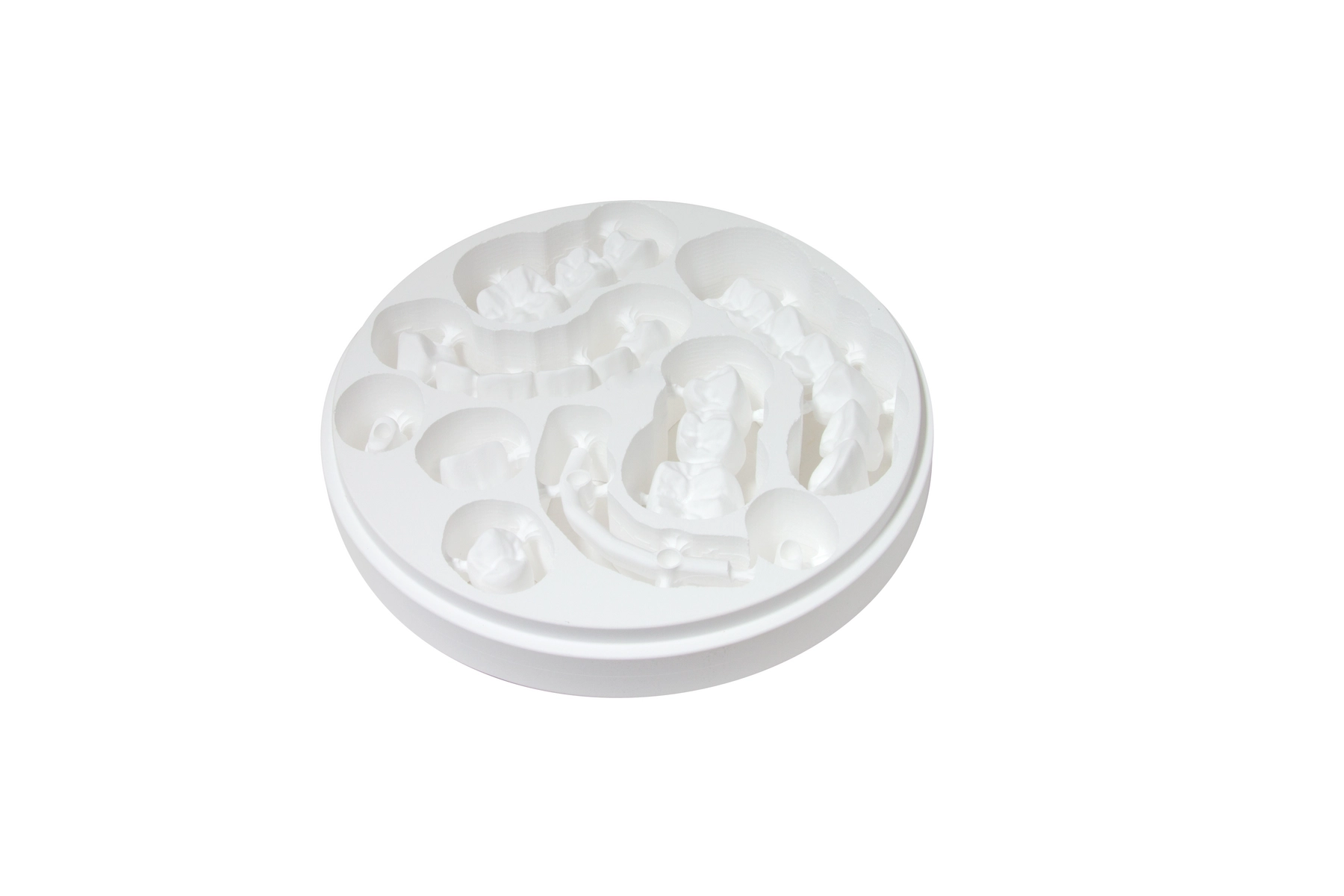
Dental zirconia is a polycrystalline ceramic based on zirconium dioxide. To stabilize its crystal structure and achieve the required mechanical properties, zirconia is commonly modified with yttrium oxide, or yttria.
The amount of yttria strongly influences the final material properties. In general, increasing the yttria content improves translucency but reduces some of the transformation-toughening effect responsible for the high strength of traditional zirconia.
This leads to an important principle:
Higher strength generally means lower translucency, while higher translucency usually comes with reduced strength.
Modern dental zirconia is therefore available in several material classes that allow laboratories to select the appropriate balance for each indication. In digital workflows, these materials can be processed efficiently with suitable dental milling machines, making zirconia a key material for CAD/CAM fabrication in dental laboratories.

The terms 3Y, 4Y and 5Y refer to the approximate molar percentage of yttria used to stabilize the zirconia.
3Y-TZP contains approximately 3 mol% yttria and offers the highest mechanical strength of the commonly used dental zirconias. Its comparatively lower translucency makes it especially suitable for posterior restorations, frameworks and other high-load applications.
4Y zirconia provides a balance between strength and translucency. It is more translucent than 3Y while maintaining sufficient mechanical strength for many anterior and posterior restorations.
5Y zirconia contains a higher cubic-phase content and therefore offers greater translucency. This makes it attractive for highly aesthetic restorations, although its lower strength must be considered when selecting indications.
Zirconia type | Translucency | Typical flexural strength* | Typical indications |
| 3Y-TZP | Low to medium | Approx. 900–1,300 MPa | Posterior crowns, bridges, frameworks |
| 4Y-PSZ | Medium to high | Approx. 600–1,000 MPa | Anterior/posterior crowns, short-span bridges |
| 5Y-PSZ | High | Approx. 400–900 MPa | Aesthetic crowns, veneers, selected restorations |
| Multilayer zirconia | Gradient | Product-dependent | Monolithic crowns, bridges, complex restorations |
*Typical ranges; exact values and approved indications depend on the individual material.
Multilayer zirconia
Multilayer blanks are designed to reproduce the natural transition from a more opaque cervical region to a translucent incisal area.
Some materials use only a color and translucency gradient, while others combine different zirconia compositions. Correct nesting is particularly important because the vertical position of the restoration within the blank determines where the different layers are located in the final restoration.

Most dental zirconia is milled in a pre-sintered state. At this stage, the material is relatively soft and can be processed efficiently before being densified during sintering.
Dry milling is the standard approach for many zirconia workflows. Because pre-sintered zirconia generates fine ceramic dust, efficient extraction and a clean milling chamber are important.
Tool selection also influences surface quality and marginal accuracy. Dental zirconia is typically processed using carbide tools specifically designed for the material. Larger tools are used for roughing, while smaller tools create margins, fissures and internal geometries.
The exact spindle speeds, feed rates and toolpaths should not be transferred universally between machines. Modern CAM systems such as iCAM V5 use predefined, material-specific strategies to coordinate machine movement, tools and restoration geometry.
Choosing the right zirconia blank
Material selection should take place before nesting and machining begin.
For a posterior multi-unit bridge, mechanical strength may be the main requirement, making 3Y or a suitable high-strength multilayer zirconia a logical choice. For an anterior single crown, greater translucency may justify selecting 4Y, 5Y or an aesthetic multilayer material.
Blank height must also be considered so that the restoration fits completely within the usable area. With multilayer zirconia, vertical positioning additionally influences the shade and translucency distribution.
After milling, pre-sintered zirconia has not yet reached its final density, dimensions or mechanical strength. These properties develop during sintering.
During this process, the restoration shrinks substantially. The CAM system compensates for this by milling the restoration larger so that it reaches the intended dimensions after sintering.
Most dental zirconia systems use final sintering temperatures of approximately 1,450 to 1,550 °C, but there is no universal temperature suitable for every material. Different zirconia products may require significantly different programs.
Temperature alone is not the only important parameter. A sintering cycle also controls:
These parameters can influence grain structure, mechanical properties and translucency. The zirconia manufacturer's specific program should therefore always be followed.
Conventional vs. speed sintering
Traditional zirconia sintering programs can take several hours, including heating and cooling. Modern furnaces and compatible materials also allow speed or high-speed sintering, significantly reducing processing time.
However, not every zirconia material or restoration geometry is approved for rapid sintering. Large bridges and full-arch restorations may require different heating or cooling conditions than single crowns.
Furnace requirements
A zirconia furnace must achieve and accurately control the high temperatures required for densification while supporting suitable heating, holding and cooling phases.
For larger restorations, controlled cooling is particularly important because rapid temperature changes can introduce stresses into extensive structures.
The complete workflow can therefore be summarized as:
CAD design → CAM preparation → Dry milling → Finishing → Sintering → Characterization and polishing
The broad range of zirconia materials makes the material suitable for many areas of restorative dentistry.
Crowns
Monolithic zirconia crowns are among the most common applications. Posterior crowns can benefit from the higher strength of 3Y or 4Y materials, while translucent 4Y, 5Y or multilayer zirconia can provide improved aesthetics in the anterior region.
Bridges
Zirconia is also widely used for multi-unit bridges. As span length increases, material strength and connector design become increasingly important.
Higher-strength zirconia grades are therefore generally preferred for demanding bridge indications. Connector dimensions and restoration design must always follow the specific material manufacturer's requirements.
Full-arch restorations
Zirconia can also be used for complex implant-supported and full-arch restorations.
These large restorations place particularly high demands on CAD design, nesting, milling accuracy and sintering. High-strength materials are generally preferred, while careful support and controlled sintering help reduce the risk of distortion or stress.
Because full-arch applications vary considerably between zirconia systems, approved indications and minimum dimensions are especially important.

Zirconia, lithium disilicate and cobalt-chromium are all important materials in digital dentistry, but their properties and manufacturing workflows differ significantly.
Property | Zirconia | Lithium Disilicate | CoCr |
| Material type | Polycrystalline ceramic | Glass-ceramic | Metal alloy |
| Strength | High to very high | High | Very high |
| Aesthetics | Good to excellent | Excellent | Low without veneering |
| Translucency | Depends on zirconia type | Very high | Opaque |
| Milling | Usually dry, pre-sintered | Usually wet | Demanding metal milling |
| Post-processing | Sintering | Crystallization | Finishing/polishing |
| Typical applications | Crowns, bridges, full-arch | Veneers, inlays, onlays, crowns | Frameworks, bars, telescopic restorations |
Lithium disilicate is particularly attractive when translucency and adhesive bonding are priorities. Its strength is generally lower than that of zirconia, but its optical properties make it highly suitable for aesthetic restorations.
CoCr offers very high rigidity and is particularly suitable for frameworks, bars and telescopic restorations. Its disadvantages are the metallic appearance and more demanding machining.
Zirconia occupies a broad position between these materials. Depending on the selected grade, it can prioritize mechanical strength or aesthetics while remaining suitable for efficient digital production.
Zirconia is not a single material but a family of dental ceramics with different balances of strength and translucency.
3Y-TZP provides the highest mechanical performance, 4Y combines strength with improved aesthetics, while 5Y offers greater translucency for aesthetic indications. Multilayer blanks extend these possibilities further by integrating optical and, in some systems, mechanical gradients within one material.
Successful processing depends on the complete CAD/CAM workflow: the right blank, suitable tools, validated milling strategies and the correct sintering program all contribute to the final result.
For dental laboratories, this versatility makes zirconia one of the most important materials for digitally manufactured crowns, bridges and complex prosthetic restorations.
FAQ:
What is the difference between 3Y, 4Y and 5Y zirconia?
The main difference is the yttria content. Increasing the yttria concentration generally improves translucency but reduces mechanical strength. 3Y is typically stronger, while 5Y provides greater translucency. 4Y offers a balance between the two.
Can zirconia be milled dry?
Yes. Pre-sintered dental zirconia is commonly processed using dry milling. Suitable extraction, zirconia-specific tools and an appropriate CAM strategy are important for efficient machining.
What temperature is zirconia sintered at?
There is no universal sintering temperature. Depending on the zirconia system, final temperatures are often approximately 1,450–1,550 °C. The exact heating, holding and cooling program should always follow the manufacturer's instructions.
Can zirconia be speed sintered?
Yes, selected zirconia materials can be processed using speed or high-speed programs. Compatibility depends on the material, furnace and restoration geometry.
Which zirconia is best for bridges?
Higher-strength zirconia such as 3Y-TZP or suitable 4Y and multilayer materials is generally preferred for bridge restorations. The appropriate material depends on bridge length, connector dimensions, position and the manufacturer's approved indications.