Founded in 2006, vFM Dentallabor GmbH employs around 25 people and has been using digital manufacturing technologies for many years. By continuously expanding its CAD/CAM capabilities and integrating various scanning, milling and 3D printing systems, the company established a solid foundation for modern manufacturing processes early on.
The introduction of additive manufacturing was therefore a logical next step. When selecting the technology, the laboratory once again chose imes-icore. A key deciding factor was the ability to combine additive and subtractive manufacturing solutions from a single provider while further expanding its in-house production workflow.
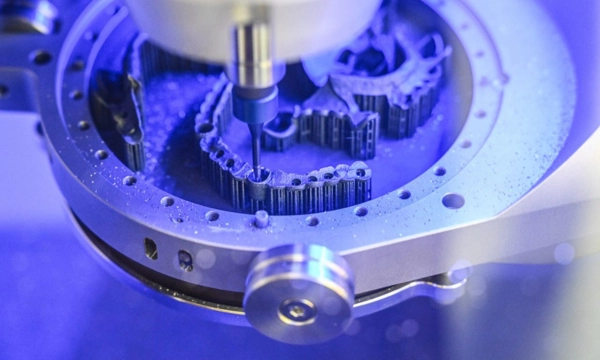
This is where the advantage of hybrid machining lies: While additive manufacturing builds complex metal structures layer by layer, subtractive finishing with dental milling machines enables the precise machining of demanding functional and fitting surfaces. In this way, the strengths of both technologies are combined within a coordinated manufacturing process.
Alongside precision, cost efficiency plays a crucial role. vFM sees significant potential for savings, particularly in manual labor and material consumption.
With the CORiTEC AM100 from imes-icore, numerous dental restorations and structures can be produced in a single build process. This allows setup times, machine operation and process preparation to be distributed across multiple units, potentially reducing average production costs per unit when production volumes are sufficient. The reuse of unprocessed metal powder through appropriate powder management also contributes to efficient material utilization.
"We see the greatest potential for savings in labor costs and material consumption."
— vFM Dentallabor GmbH
Additional business opportunities arise from providing manufacturing services to other dental laboratories. vFM also uses its available production capacity for external orders, giving partner laboratories access to advanced metal 3D printing technology without having to invest in their own equipment.
This not only leads to more efficient manufacturing processes but also creates opportunities to maximize production capacity and generate additional value.


The benefits of hybrid machining become particularly evident in the production of demanding telescopic restorations.
For many years, vFM used various subtractive manufacturing methods to achieve precise fits between primary and secondary crowns. By combining optical and tactile data acquisition with subsequent additive manufacturing, the laboratory has been able to further improve the quality of its telescopic restorations based on its own experience.
The high precision of the coordinated workflow is particularly noticeable in thin, tapered marginal areas. At the same time, complex removable partial denture frameworks and secondary crowns can be manufactured in a single piece, regardless of their size, without internal stresses.
For vFM, hybrid machining therefore offers significant advantages in terms of fit accuracy, reproducibility and process reliability, particularly for complex metal structures.
vFM's experience demonstrates that successful hybrid manufacturing requires much more than advanced machinery. The key is a seamless workflow in which data acquisition, CAD design, additive manufacturing and finishing processes are optimally coordinated.
Equally important are well-trained employees and a thorough understanding of the processes involved. Thanks to its extensive CAD/CAM experience, the Hamburg-based laboratory was able to integrate the new technologies into its existing operations with manageable effort.
Digitalization does not replace traditional dental craftsmanship. Instead, digital precision and the expertise of skilled dental technicians complement each other to create a highly effective manufacturing process.
By adopting hybrid machining, dental laboratories can expand their range of services, manufacture complex metal restorations with high precision and unlock additional business opportunities.
If you are interested in the whole success story, read the user story published in the ZWL issue 5.26 on pages 52-53: